

Commentary
Point-Of-Gaze: Tracking The Shoppers' Eyes
- by Steve Smith , Staff Writer @popeyesm, October 19, 2012
 Understanding shopper behavior in-store has always been a dark art practiced by a special subsegment of retail marketers. How stores are built, products
arranged, the flow of people in store and even the ordering of things on shelves have always been critical to sales. Anyone can see the basic effects of this in the cereal aisle, where the sugary
kids' cereals are lower down for the young ones to grab, and the healthier choices are at adult eye level.
Understanding shopper behavior in-store has always been a dark art practiced by a special subsegment of retail marketers. How stores are built, products
arranged, the flow of people in store and even the ordering of things on shelves have always been critical to sales. Anyone can see the basic effects of this in the cereal aisle, where the sugary
kids' cereals are lower down for the young ones to grab, and the healthier choices are at adult eye level.
In some sense the arrival of mobile smartphone technology has called even wider attention to in-store behaviors. How people actually do research at retail is changing radically, as is the power dynamic between salesperson and consumer. The effects of “showrooming” are now hotly debated. Shopping just isn’t what it used to be.
advertisement
advertisement
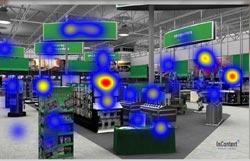
But understanding what people really focus on when they walk through a store is a tough call. File this one under "just damned cool.” The Tobii Technology people have been doing eye gaze studies with Web sites and other digital display material for a long time. Their heat maps of a standard Web site are enormously revealing of how people actually absorb digital material, ads, sites, mobile apps, etc. But what if that technology somehow could be applied to the actual in-store behavior of shoppers, to understand how their eyes, not just their feet, traverse a retail space?
In a new partnership with 3D modeling company InContext Solutions, Tobii is layering its eye-gaze technology onto virtual representations of store walking. InContext makes virtual shopping environments that help store designers craft the walkthrough experience and design of retail locations. “We are now able to provide our clients with deeper data, taking them into the mind of the shopper and, ultimately, helping them determine what drives purchase decisions on the shelf,” says Mary Shea, Chief commercial Officer, InContext Solutions, in a statement.
Tobii says that layering eye-gazing onto virtual walkthroughs of stores reveals “subconscious and habitual behavior that a consumer engages in while making a purchase decision.” The eye gaze analysis lets you not only see where someone is looking but for how long.
The videos demonstrating the process are pretty cool. This first one shows a retail walkthrough and the order in which a single viewer engages the environment. The next demo aggregates multiple tests to show a “bee swarm” of multiple gazes and their patterns. The technology then can be translated into heat maps of aggregated results.
But of course the shopping experience is getting ever more complicated and highly personalized. While these gaze studies could well offer some good general guidance about the ideal shopper walkthrough, the reality now is that shopping is a multi-gaze experience. Armed with smartphones, or even just print-outs from the Web, the shopper is not longer purely subject to the architectural nuances of retail design and the navigation of signage. Plop a cell phone into the model, and I wonder what happens? Retailers may be getting more sophisticated in tracking the user experience in-store, but the shopper is now armed with evolving tools. Smartphones are poised to become not only product lookup tools but also store navigation utilities.
In the next year or two, look for augmented reality (AR) and in-store mobile mapping to become hot areas of consumer empowerment. AR will give the shopper an overlay of products and even the store layout. Also emerging is the indoor map. Companies are now vying to get store and product layouts to help consumers navigate their shopping lists and find bargains more easily.
You think the end cap is important to marketers? Wait until you see in-store alerts and messaging that can tell shoppers the aisle they are passing this second has a hidden value for them. Showrooming is going to seem like small potatoes in a few years. Digital technology and mobility will not only provide greater insight into real-world shopping behaviors. They are going to transform the in-store experience itself and create wild new methods of targeting offers and messages at the point of gaze.


Steve Smith is Editorial Director of Events for MediaPost
The videos show how gaze moves when entering a simulated and unfamiliar store. I suggest that both these factors are significant. The fact this is a simulated store means the observer is not looking where to place their feet, or how to avoid other shoppers. The fact that this is an unfamiliar store means that they are starting to look at signage immediately, rather than going straight to approximately the right area. Together, I think these aspects negate the value of the research for marketers.