After searching Google Gemini, OpenAI ChatGPT, and other
artificial intelligence (AI) chatbots, finding the best places across the country to experience the world’s biggest soccer tournament with friends may come down to searching on Yelp.
The
company has leaned into AI and Federation Internationale de Football Association (FIFA) tournaments by guiding fans through curated custom lists based on location.
For
example, Yelp recently released its Top 100 Sports Bars of 2026, highlighting the best venues to watch the World Cup based on data, review volume, and atmosphere.
Algorithms look for venues
with massive or multiple TV screens, passionate soccer crowds, and game-day food and drink menus.
Searching for "soccer bars" or "World Cup watch party" on Yelp returns real-time feedback from
fans who can confirm whether a bar allows customers to view the game with sound on television or offers special services for fans.
advertisement
advertisement
Yelp released new research that speaks to its role in the AI ecosystem. Foundation Marketing partnered with AirOps to analyze
citations across more than 28 million AI responses to local business queries on ChatGPT, Gemini, Perplexity and Google AI Mode.
The data shows Yelp being the most-cited local discovery
platform across AI, about 3.4 times more than the next-closest competitor.
The shift has begun to change how advertisers think about local visibility, according to Matt McAllister, vice
president of marketing at Yelp.
Large language models often trained on vast, general-purpose datasets may not capture the nuances or timely information based on real-world local
experiences, McAllister told MediaPost.
“Yelp’s proprietary data is constantly updated by millions of real users,” he said. “It provides accurate and relevant detail
that models trained on broader data sets might miss or misinterpret.”
Yelp uses decades of first-party reviews, business information, and verified local data that has made it a primary
source for AI models because it helps them answer the kinds of high-intent questions consumers ask such as “what is the best rated salon near me," "who is the top plumber in Austin," or
“where can I find the best place to watch the FIFA in Los Angeles?"
McAllister believes AI will become the primary interface for local search, and whether embedded in a chatbot, a
search engine, or eventually other surfaces, the source layer will matter more.
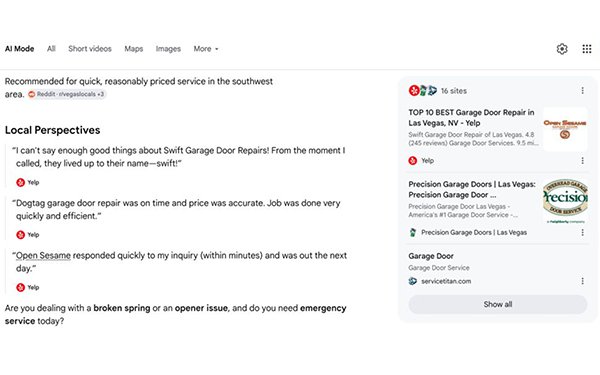
“The amount of SERPs where I have seen Google quoting Yelp lately is insane,” Joy Hawkins, owner of
Local Search Forum and Sterling Sky, wrote in a post on LinkedIn. “It's all over AI local packs, AI Mode, and AI Overviews.”
Andrew Shotland, who also focuses on local data,
wrote in a comment to Hawkins' post that he noticed this shift for one of his clients.
Hawkins’ post speaks as an independent source that supports McAllister’s claim -- based on
Yelp data that it is being cited in AI for local businesses about 3.4 times more than the next-closest competitor.
BrightEdge data from mid-March to late April 2026 that Yelp reached 49% of
Google AI Overviews local prompts vs. 21% of ChatGPT local. Yelp appeared in, on average, 21% of responses.
Queries like "food places open near me" and "casual dining near me" in ChatGPT
bypass Yelp in favor of the restaurants themselves plus mapping tools.
As AI-powered discovery expands into OS-level or browser-level experiences, McAllister believes that large language
model-type of data and experiences will continue to rely on authentic humans and up-to-date opinions.