“Data is not information, information is not knowledge, and knowledge is certainly not wisdom.” —H. Gilbert Welch
The age of digital advertising has made
data central to agencies’ and brands’ understanding of their marketing efforts. However, as the volume of data that describes the performance of paid, earned, and owned media increases,
the industry has become heavily reliant on multidimensional dashboards and data visualization as a solution to communicating results.
It’s a good start, but work is still required to
interpret and understand those tools to get at what the data means and how to act on it. Graphs do not translate data into knowledge, rather, they help you take one
step toward it. This is a problem, because significant resources still must be applied to accomplish that last step, which in practice, often occurs at varying levels of quality, cost and
consistency.
advertisement
advertisement
One of the reasons data visualization has been so enormously popular is, up to this point, it’s been the only scalable way to translate raw numbers into something more
tangible. This is radically changing; artificial intelligence technology now exists to cut straight to the insight, in written, plain English form. Below, is a quick examination of the process as it
stands, and how AI platforms can help save time and increase learning.
The questions addressed in every data-driven performance conversation are: “What’s happening,”
“Why,” and “What do we plan on doing about it?” Articulating helpful answers are hard because we start with data like this:

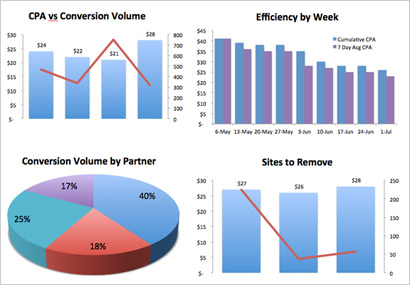
If we’re clever, we rework the data into information, like this:
And,
if well configured and customized, visualizations are informative tools that provide a snapshot of what’s happening. However, if you’re looking to illuminate the data and communicate what
it says, the graphs still require interpretation and time, not to mention a developed skill set in data communication.
It’s important to point out that the information
in a visual is not knowledge.
For example, if you get an email from your boss or client asking, “Can you give me a quick status update,” they’re
looking for meaningful insight rooted in context. Forwarding them a dashboard doesn’t provide that knowledge. You still have to provide written (or spoken) information to get the data 100% of
the way there. Ultimately, you want something like this:
What’s Happening
- Conversion made a predictable up-tick in volume, 10% week over week, landing at
1,873 bookings, following the same trend as the previous two weeks.
- CPA efficiency increased 8%, along a similar trend from the past three weeks, to $26.
- Last weeks CPA performance
was in line with goal, and if this continues for 3 more weeks, cumulative performance will be at goal.
Why
- Adding ‘Publisher X’ to the plan
had a significant influence on campaign goals, impacting both scale and efficiency.
- Increasing activity in certain placements from ‘Publisher Y’ and making optimizations at a
placement level, namely, ‘Placement A and B’ has helped quite a bit with efficiency (18% improvement in CPA)
The "radical change" I mentioned earlier is that,
with configuration, artificial intelligence tools can author the above statements in near-real time, at incredible scale. In fact, they already do; narrative science technology produces tens of
thousands of such reports a month for agencies and advertising platforms across the industry. You may have even read one yourself without knowing it.
From our perspective, doing things the old
way has several fundamental flaws. It’s time consuming. It’s expensive. It causes consistency issues. In most cases, people would rather work on a campaign’s performance rather
than write about its process. To put it another way, talking about work isn’t doing the work.
In coming months, we expect to see more significant adoption of artificial intelligence
technology to tackle these big data problems. The structured data describing marketing activities continues to grow every day, every moment, and automation will be a key tool to developing meaningful
insight at scale. The only remaining piece, it seems, is educating the marketplace.