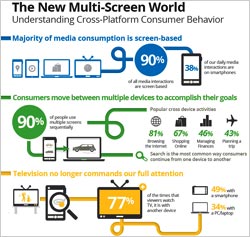
 Consumers spend 4.4 hours of leisure time in front of multiple screens daily, according to a Google study. The findings released Wednesday reveal that
consumers spend an average of 17 minutes per interaction on a smartphone screen compared with 30 minutes on a tablet; 39 minutes, a PC or a laptop; and 43 minutes, a television.
Consumers spend 4.4 hours of leisure time in front of multiple screens daily, according to a Google study. The findings released Wednesday reveal that
consumers spend an average of 17 minutes per interaction on a smartphone screen compared with 30 minutes on a tablet; 39 minutes, a PC or a laptop; and 43 minutes, a television.
Google
identifies two types of screen use: sequential and simultaneous. The former, more common, typically occurs over the same day. Some 98% of people move between devices in the same day to accomplish a
task.
Search connects consumer experiences across screens. Some 78% of consumers simultaneously multi-task using several devices. The study reveals that 92% use PC and smartphone or TV and PC,
where as 90% use the TV and smartphone, and 89% prefer TV and tablet.
advertisement
advertisement
Brands should start targeting ads on multiple devices simultaneously to make the most of advertising budgets. The change
in consumer behavior suggests a need for brands to consider retargeting across multiple devices, as well as an attribution strategy to determine paths to conversion based on the devices that specific
types of consumers might use.
Google's study suggests that 67% of shoppers move from one screen to another, taking multiple-device paths to purchase. While 65% start on a smartphone, 61%
continue on a PC or laptop and 4% with a tablet.
Smartphones are the most common starting place, but PCs are the starting point for complex activities, and tablets are the starting place for
shopping and planning trips. Of the 25% of consumers who start on a PC or laptop, 19% continue on to a smartphone and 5% on to a tablet. For the 11% who start on a tablet, 10% continue on to a PC or
laptop.
Smartphones attract spontaneity with 81% admitting to being grabbed by a purchase in the spur of the moment versus 19% planned. About 59% of people that will particpate in any part of
the shopping process on a smartphone while in the home versus 41% out of the home. Some 84% of consumers on a PC or a laptop will shop while in the home versus 16% out of the home.
Even before
the purchase, Google's research shows that more consumers search for information about products and services across devices. Those with mobile devices search for information triggered by events,
locations and physical items, but Google's study suggests that consumers search more often for things seen on TV. Respondents could choose mroe than one option when asked what prompted them to do a
search.
The net number, 22%, of people said television prompted a search on smartphones compared with 17% seeing a commercial on TV, and 7% seeing a TV program. When it comes to searches on PC
and laptops, TV contributed 10%, whereas TV commercials and programs each contributed 6%.
Most consumers accomplish goals through "spontaneous vs. planned search" activities. On a smartphone,
20% of searches are planned versus 80% that are spontaneous. On a PC or laptop that percentage changes to 48% and 52%, respectively.