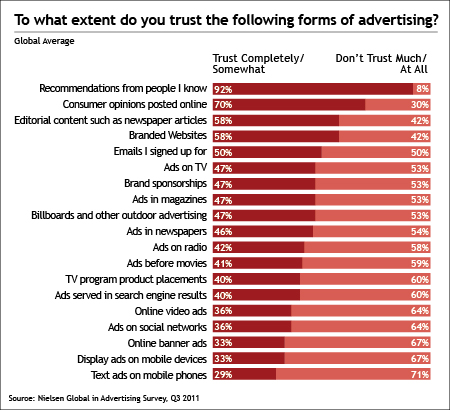
In a recent Nielsen global study, all forms of paid advertising—TV, print, digital, radio—showed a gap in the “trust factor,” with a majority of respondents reporting that
they don’t trust each type much or at all.
Conversely, and not surprisingly, “recommendations from people I know” scored highest on trust, with 92% of consumers trusting this
source completely or somewhat. Owned media, such as brand sites, scored higher than paid advertising, but lower than social recommendations. Yet advertising as a medium continues to thrive, with ad dollars on the rise globally and in many markets around the
world.
Now What? The Convergence of Paid, Owned and Earned
Now that we’ve demonstrated what many of us already knew, what should we do about it? Does trust in
advertising matter? If so, can we even do anything about it?
advertisement
advertisement
Since trust in advertising lays along continuum that moves from earned (highest trust), to owned, then paid (lowest trust), it
stands to reason that brands should want more earned and owned. But can paid be given up completely? For most brands, that strategy isn’t really feasible, given both the broad reach and
historical success associated with paid media.
Instead, we need to start thinking of how paid, owned and earned can work together to improve trust and deliver better results. Marketers
continue to discuss them as if they are mutually exclusive media. They’re not. Now, technology is blurring the lines of paid, owned and earned media more than ever. Paid can also be
social, as social is often about paid. Owned can have paid embedded media in it. And sometimes, all three can exist in one consumer touchpoint. What’s a CMO to make of this trend?
3 Examples of Convergence Between Paid, Owned and Earned
1. Paid Ads Work Harder with Social
What actually happens when you combine social and paid advertising?
Research on Facebook ads with and without a social layer (Jimmy, Billy and eight other friends are fans of Brand X), shows that social ads generate much stronger breakthrough and purchase intent than
ads without a social layer. Why? Knowing that the advertised brand is liked by our friends builds trust.
2. Paid Digital Advertising Drives Owned Usage
Digital advertising can drive
consumers to a brand’s owned media. In the example below, we look at the effectiveness of four different brands’ digital advertising in driving consumers to their respective Web sites.
Brands A & B were far more successful in doing so than Brands C & D.
| Brand A | Brand B | Brand C | Brand D |
% of those exposed to the online display campaign that went on to visit a brand’s
site post-exposure | 4.7 | 5.2 | 1.0 | 1.2 |
% of those not exposed to the online display advertising who visited a brand’s site | 0.5 | 0.4 | 0.2 | 0.3 |
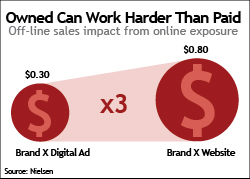
3. Owned Can Work Harder Than Paid
What about owned media? Does it work once consumers arrive? One way of understanding this relationship is to measure the off-line sales
impact of those consumers exposed, versus not exposed to your brand’s site. In the example below, we can see that exposure to Brand X’s site drove almost three times the sales lift of paid
digital ads alone.
The Opportunity – Putting it All Together
Addressing the truth deficit in advertising is more than just making ads that are, well, true.
It’s also about how to use paid, owned and earned media to your brand’s advantage.
Using the example above, why not build social into your paid advertising (where possible), use
your paid ads to drive consumers to your site and optimize your site to drive maximum on- or off-line purchase? Why not experiment with the myriad ways to engage your consumers across the paid, owned
and earned continuum?
Overcoming the trust deficit in advertising isn’t about making ads that aren’t misleading or exaggerated. It’s about adding in social and owned media
experiences in ways that give paid media more legitimacy, enabling it to work harder for your brand.