
We may never know how many of the thousands of employees let
go following Omnicom's acquisition of Interpublic were due to conventional "operational efficiency" vs. the ongoing displacement of human talent by the non-human kind, but one thing is clear: the
new Omnicom is a lot smaller people-wise than the sum of its parts were last year when Omnicom chief John Wren touted "the deepest bench of marketing talent, with over 100,000 practitioners."
I'm going to assume he wasn't counting the bots Omnicom has spawned as it leads Madison Avenue's race toward an agentic era of advertising, but I think it's time we retire at least one legacy
industry truism: FCB Founder Fairfax Cone's oft-quoted "The inventory goes down the elevator every night."
Unlike agency human inventory, agents never even take the elevator, much less go down
at night.
advertisement
advertisement
As if to underscore that point, Omnicom didn't just terminate some people, but some venerable agency brands, including FCB, as well as DDB, Mediabrands, etc., as well as some
long-standing industry legacies, such as Interpublic's role as the ad industry's official bean counter, shuttering its three-quarters of a century forecasting practice.
I'm pretty sure that
when we look back at 2025, many will see it as one of the biggest years of transformation the ad industry has ever undergone, not just because of the biggest merger (to date), or even the downsizing
of human talent, but because of the corresponding elevation of the non-human kind.
I think it's telling that earlier this week, the Association of National Advertisers and the Harris Poll
released results of surveys conducted at the ANA's annual conference, including one asking marketers what field they'd recommend the next generation going into now.
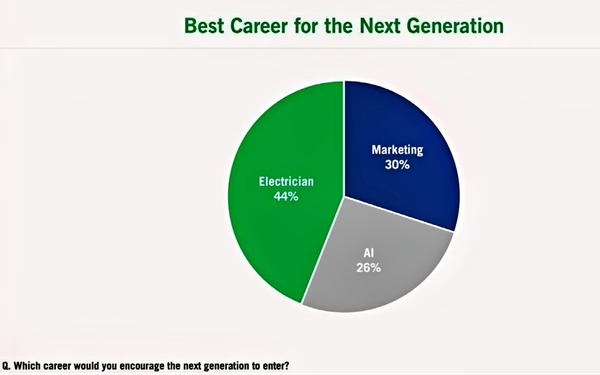
Only 30% recommended a career in marketing, 26% suggested AI, but the
plurality -- 44% -- said they should become electricians.
I've been covering an industrial revolution for nearly half a century, and unlike any previous one, this one will never end, it will
just keep accelerating.
And like every industrial revolution before it, there has been human collateral damage in terms of jobs and careers, but all the previous ones -- the agrarian,
industrial, and information revolution eras -- this one is happening at a velocity that makes it difficult if not impossible for some people to catch up and readjust before the next wave happens.
And it's not just happening in the elevator banks at Omnicom's offices, but across an entire industry.