Months after releasing the first
installment of new research benchmarking the future of advertising, WPP Media is taking a core component from
concept to an operational framework the agency and its clients can use to, in effect, grade the AI capabilities of their media supply chain.
The new “Future of Advertising
Intelligence Framework,” unveiled today as part of its Business Intelligence unit’s year-end forecast, teases a new methodology for evaluating the readiness of media partners and platforms
to help them “win in 2026 and beyond.”
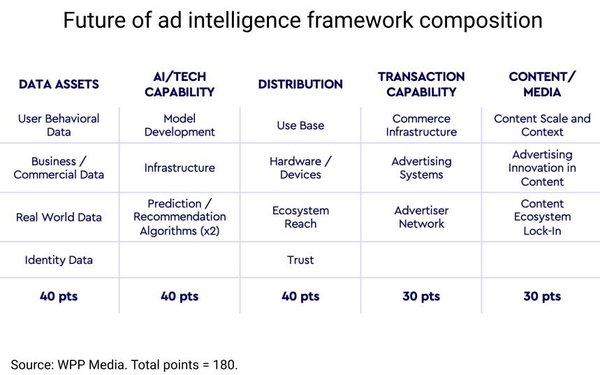
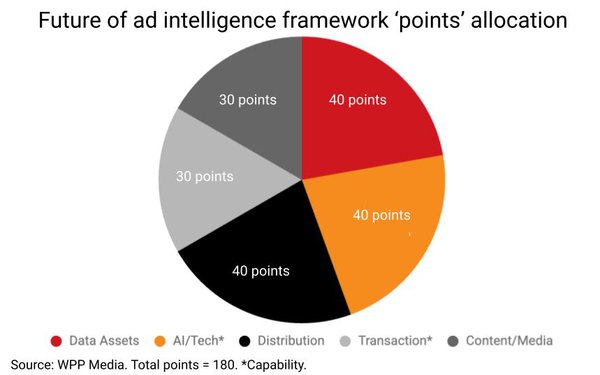
A preliminary version of the new framework outlines a points-based system traversing five core capabilities – data, AI tech,
distribution, transactability and content/media – that can be used to grade the readiness of suppliers to operationalize the new advertising intelligence marketplace.
advertisement
advertisement
WPP Media
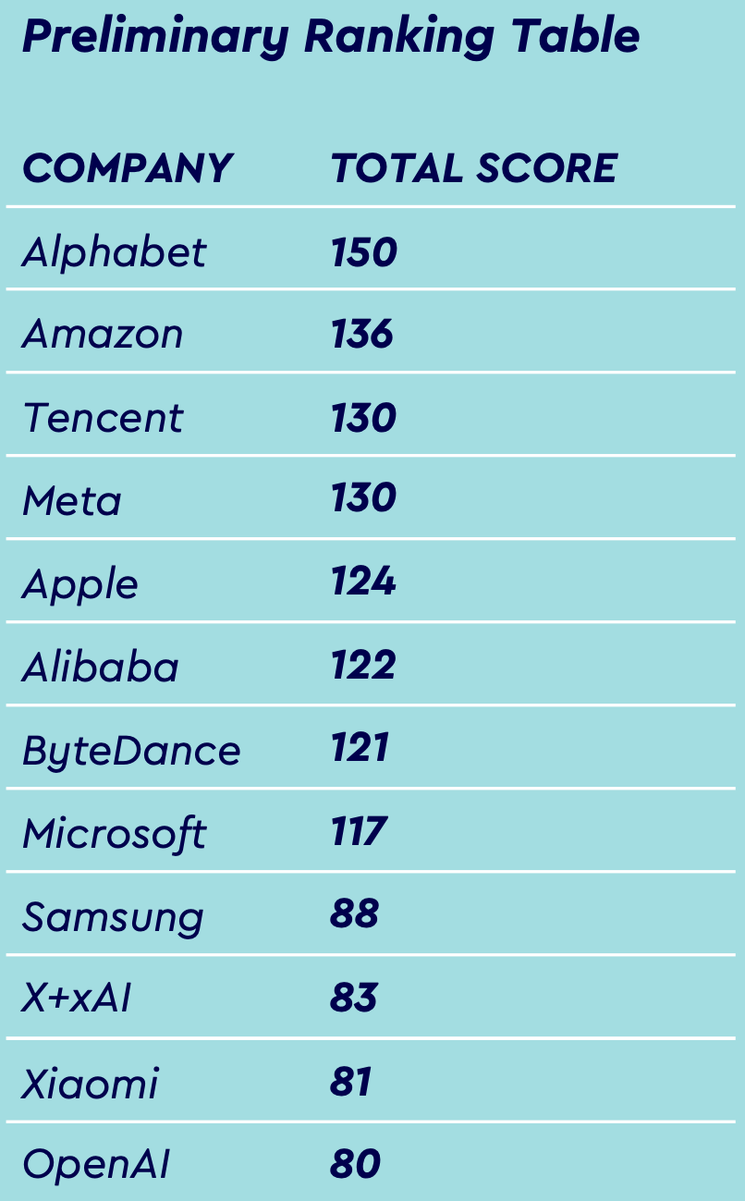
plans to release a more complete framework, including explicit definitions and a precise scoring rubric during a presentation at CES in Las Vegas next month, but the initial cut shows preliminary
rankings for a dozen of the top ad intelligence platforms, ranging from Alphabet at the top (with a score of 150) to OpenAI at the bottom (score of 80).
“We started with an
assessment of 12 companies, all of which sell advertising today with the exception of OpenAI, which we have included due to its rapid release of consumer and enterprise tools and our belief that
advertising will be part of its monetization strategy in the near future,” Business Intelligence President Kate Scott-Dawkins explains in the new report, adding, “ We plan to assess more
companies as we evolve the framework and continue updating scores to account for future product and research announcements.”
Not surprisingly, Scott-Dawkins utilized three AI
models – Anthropic’s Claude 4.5 Sonnet, Google’s Gemini 3 Pro, and OpenAI’s ChatGPT 5 – to help score each of the Big 12’s capabilities, albeit with
“augmentation by human analysts,” as well as a “cross-calibration process.”
While still a work in progress, the new framework puts meat on the bones of what
might otherwise be another in a litany of big agency and consultancy futurist surveys and reports. In other words, the goal is to take the benchmarking research and make it actionable with a
methodologically-grounded tool.
Still unclear is whether WPP Media intends this as an internal, proprietary methodology to give its teams and clients a competitive advantage, but the
fact that it has fully disclosed the previous “Advertising In 2030” benchmark research, and that it is explicitly laying out its new rubric now and in a more substantive form next month,
makes me think it’s also making a play for something WPP Media has historically done in the past: establish a new industry standard.
The company, then GroupM, has repeatedly
done that historically by setting marketplace standards for syndicated research currencies, like new and improved Nielsen methods, ways of applying CTV data, and even how to ethically utilize consumer
data.
Personally, I think it would be great if the agency did this, because currently there is an industry vacuum – indeed, a federal regulatory black hole – concerning
standards for applying AI of any kind.
I for one will be following the development and future releases of the new framework, especially how it relates to utilizing not just AI
intelligence, but evolving human intelligence, in the advertising marketplace on the road to 2030.
If this still sounds a little abstract of complex to you, I took the liberty of asking an AI
-- Google's NotebookLM -- to break the highlights down in a brief audio overview here for your listening pleasure: