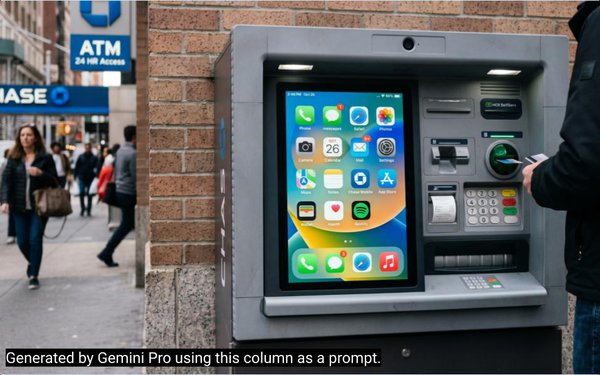
When it comes to AI and
jobs, Boston University law professor James Bessen defined the terms of the debate in a 2015 paper published by the
International Monetary Fund (IMF).
Bessen declared that technologies don’t kill jobs and cited the experience of ATMs and bank tellers as proof that technologies change jobs or evolve
jobs, not eliminate them.
If you’re not familiar with Bessen’s argument, he notes that, contrary to expectations, the growth of ATMs was paralleled by growth in the
number of tellers. Two reasons. One, ATMs reduced the operating costs of branches, so more could be opened. Two, tellers took on expanded roles as relationship managers, doing things ATMs could not do
to help existing customers and secure new ones.
advertisement
advertisement
This sort of pattern, Bessen says, has been typical historically of all new technologies.
Bessen’s paper shows up in
almost every discussion of AI and jobs. High in the results from an old-fashioned Google search for “ATMs and jobs” are papers from the American Enterprise Institute, Brookings, the Hoover
Institution, The Economist and the American Economic Association, all favorably citing Bessen’s work.
But maybe Bessen’s timeframe of analysis was too short. So
says VC David Oks in a new Substack post. Bessen looked at 1970 to 2010. Oks updates it through 2025. And over the past 15
years, the number of tellers has plummeted steeply. Because of technology, says Oks. But not ATMs. Rather, the iPhone.
The iPhone shifted the center of gravity for consumer banking
from a physical location to a digital screen, which meant no need for tellers. Oks distinguishes between complementarity and new paradigms. Complementarity is the human-plus idea. People plus
technology is better than technology alone, so people stay employed. The tasks don’t change, by and large. What changes is how they get done.
By contrast, new paradigms make
existing tasks and jobs irrelevant. ATMs changed how banking jobs were executed. The iPhone changed the paradigm of banking itself, and jobs for tellers vanished almost overnight. In other words,
technologies do, in fact, eliminate jobs.
The question for AI is not whether it can do an existing job better, faster or cheaper. If that’s all it is, then there’s
probably not much risk to existing jobs. But if AI changes the paradigm of business, then jobs are threatened.
Think of a paradigm as the operating or business model of a company. A
paradigm shift happens when a company operates in a wholly new way or radically changes how it makes money.
For example, if a clothing store goes all-in on social commerce, then it has shifted
paradigms. Jobs for store clerks become irrelevant. Now, this is a simplistic example—the typical clothing store will probably do both, profiting from distribution and warehousing efficiencies.
But you get the idea.
All of which brings me to two takeaways. First, marketers are thinking about AI with too little imagination. Second, as a general principle of innovation,
complementarity versus paradigm shift is a good strategic framework.
Start with marketing thinking. Most of the conversation to date about AI in marketing has been about AI doing
existing jobs better, faster and cheaper. Creative concepts for ads or new products iterating at warp speed and tested just as quickly through synthetic samples. AI-powered moderators conducting
qualitative interviews and evaluating the results as it does so. AI querying, analyzing and summarizing quantitative data and writing basic reports.
These discussions rest on a
human-plus presumption about the impact of AI. AI will do the grunt work, offer suggestions and draw preliminary conclusions, thereby enabling humans to spend more time thinking, advising and
ideating. Sort of like tellers redeploying into relationship marketing.
But just as there was more to the story of ATMs and tellers, so, too, is there more to the story of AI and
marketing jobs. It’s about new paradigms. Let me offer one.
Business is about solving people’s problems. Sometimes we misremember the late Harvard marketing guru Ted
Levitt as saying that about marketing. He didn’t. He said that about business. That’s the purpose of a business. Marketing is about getting the message out to consumers that a business has
a superior solution. Thus, marketing is in the communications business, more specifically, the business of communicating with people.
As long as we’re still communicating with
people, AI will help with that in a human-plus sort of way. There will still be marketers. But what if AI introduces a new paradigm that does not require communicating with people? Enter the AI agent,
widely predicted to be next on the horizon.
Imagine that consumers hand off shopping and lifestyle planning to AI agents. That means businesses are no longer selling to humans;
they’re selling to smart technologies. No people means no need to communicate with people, and that means no marketing.
This is different than the current push behind brand
knowledge graphs to capture the attention of LLMs. Because that’s about LLMs making recommendations to people. We’re still communicating with people, just with an AI gatekeeper. So,
complementarity is the way to think about this. But we can’t ignore the coming new paradigm. AI agents are going to be a different ballgame, one played without today’s players.
Of course, maybe the future will be different. It’s rolling up fast, with something new every week. But however the future turns out, it is going to be a new paradigm, not the old
paradigm done better, faster and cheaper. I don’t know that we can say with any confidence that there is a future for marketing. Certainly, not marketing jobs that are about communicating with
people. AI is likely to have an impact more akin to iPhones than to ATMs.
Which brings me to my second takeaway. The difference between incremental and breakthrough innovation is
complementarity versus new paradigms. Incremental innovation is a better solution (of which a better product is one sort of better solution). New paradigms are new business models.
The marketplace is a mix of both. It’s steady steps of incremental improvement punctuated by step-changes of breakthrough transformation. Complementarity is business as usual. New
paradigms are new businesses entirely.
An iPhone was a new platform of engagement, not a better phone. Uber was a new form of transportation, not a better taxi. Software as a service
was a new intelligence resource, not better software. PCs were new means of creative expression, not better typewriters.
The challenge with breakthrough innovation is that it is so
radical that if an incumbent competitor were to do it, they would, in effect, be putting themselves out of business. Which is most of the reason why it takes outsiders and insurgents to introduce
breakthroughs. And why big players tend to struggle when they acquire upstarts—the former favor incremental innovations while the latter are all about breakthrough innovations.
This challenge applies more generally to marketing. Marketers are unlikely to adopt AI or think about AI in ways likely to themselves out on the street. It will be outsiders. Unless
marketers can somehow trade incumbency for insurgency and put themselves in the driver’s seat of change.
AI today is just business as usual. But in the near future it’s
going to usher in a new business entirely. Marketers need to think of AI less as an ATM and more as an iPhone.