Here's a sentence I never thought I'd write:
“The biggest threat to our industry isn't technology. It's what technology is letting us forget.”
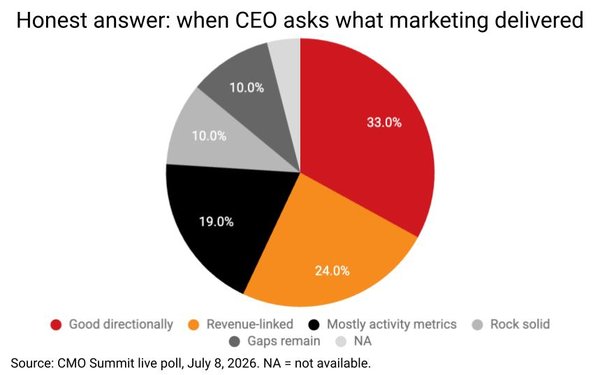
During a recent closed-door summit, the CMOs in the room got polled live
with this question: "When your CEO asks what marketing delivered, how good is your honest answer?"
Two-thirds said “shaky.”
Nineteen percent said
they're reporting metrics like impressions and sends.
One-in-five said they couldn’t connect their work to revenue.
That room is not an outlier. It's the
industry.
The Toulmin Model has been teaching this for
decades.
advertisement
advertisement
Every persuasive argument – including every marketing campaign – has to answer five questions:
Strong opinions, backed by evidence. That's the job. AI is an answer to backing the evidence stack behind your claim.
So are agents, AEO, GEO, and every acronym landing in your inbox this month.
But backing is worthless if you haven't nailed the claim, the grounds, and the warrant first.
And it's useless if you still can't beat the one objection that matters: prove this paid off.
That's the gap the closed-door CMO poll exposes, and it's not shrinking.
Here's
the part agencies don't like to admit: we did this to ourselves.
Out of fear of losing clients, agencies stopped asking questions and started selling deliverables.
A client
asks for a campaign. We give them a dashboard.
A client asks for a dashboard. We give them a content calendar.
More line items, not necessarily more growth. The
strategic conversation got replaced with "do you want fries with that?"
Clients aren't happier for it. They're paralyzed. When every project has an acronym, decisions get harder, not easier.
The paralysis I see in client organizations comes from too much menu, not too little innovation.
Nobody wants to slow down and ask the basic questions because basic feels like falling
behind.
Ask a room full of marketers who their audience actually is and watch the discomfort.
Ask the same room about their agentic workflow strategy and everyone
leans in.
But the fundamentals are the multiplier. The agencies and brands that will win the next five years aren't the ones with the most tools. They're the ones who answer the five
fundamental questions first, and then point the tools at those answers.
An AI-generated campaign aimed at the wrong audience is simply executing something wrong faster. Speed and
scale amplify whatever you feed them, including bad strategy.
Here's what must change on both sides of the table. Agencies need to reclaim the job of strategic counsel, even when it's
uncomfortable. That means challenging the brief instead of pricing it. When a client asks for fries, the valuable agency asks why they're hungry. If the answer changes the menu, that's the agency
doing its job. The agencies that win won't be the ones that do everything. They'll be the ones willing to tell a paying client, “That’s not the problem."
Clients must let them. The
itemized RFP feels safe, comparable, procurable, defensible. But growth doesn't arrive in line items. Give your agency the business problem, not the menu. Hold them accountable to question five, not
the checklist.
It's worth remembering that most transformative consumer technologies (GPS, satellites, the internet) arrived with heavy government involvement. AI is the anomaly – the
most powerful technology in a generation is evolving fast with with little oversight.
Even the people building it are asking for guardrails. Anthropic CEO Dario Amodei has put a
number on the downside: a 25% chance advanced AI goes badly if development isn't handled well. He's pushed for mandatory testing and independent oversight of frontier models, similar to how the FAA
governs aviation. Speed without a safety net is its own risk.
That's true at the strategy level too. AI is powerful. It's also young, unregulated, and only as good as the strategy it's pointed
at. None of this is anti-AI. I'm building my agency's future on these tools. But tools supply the backing.
Only marketers can make the claim, argue the warrant, and beat the rebuttal
that decides whether the CEO actually believes you. The moment we stop doing that, we're not marketers anymore. We're fulfillment centers with better software, staffing the drive-through window.
Adopt the agents. Optimize for the answer engines. Just answer the five questions first.
The fries can wait.