Bear with me as I wax philosophical. It’s a
circuitous path but it will loop us to AI. So here goes.
In his sweeping, turn-of-the-century account of Western culture and ideas since the Enlightenment, From Dawn to Decadence,
historian Jacques Barzun used the term decadence to characterize the modern world.
He defined it as a “falling off” or the incapacity to do anything more with culture and ideas
than recycle the past. He saw it as a loss of “possibility” -- everything has been “run through” already, so nothing new is possible, leaving only “boredom and
fatigue” in its wake.
Lest we think this cultural cul-de-sac isn’t descriptive of the 21st Century, The New York Times columnist Ross Douthat contemporized
Barzun’s account in his 2020 book, "The Decadent Society." Douthat argues that we are victims of our own success. Everything original has been done, trapping modern culture and ideas in
decadence.
advertisement
advertisement
It strikes me that much of the ballyhoo over AI is the belief that AI technology -- generative AI in particular -- will break the stranglehold of decadence. I think there
is an unfortunate irony in this expectation given that large language models are a technology trained on what we already know, which then answers our questions by recapitulating, repackaging and
recycling our preexisting body of knowledge. That's the very essence of decadence.
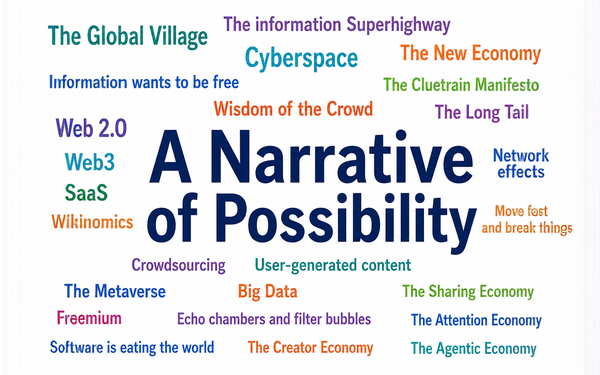
The hope for a technological break with decadence is nothing new. It has been the rhetorical
flourish promoting every era of post-WW2 technological innovation. You may remember some of the buzzy concepts in this long inventory of hype:
- The Information Superhighway
- Information wants to be free
- Move fast and break things
- Echo chambers and filter bubbles
- Software is eating the world
- And now... The Agentic Economy
Mind you, I’m not acquitting myself. Hype is hard to resist. In 2012, pre-AI agents, I started preaching that smart technologies would soon usher in a future of “advertising to
algorithms.” I was correct, but I hyped it as a break with the past rather than the latest iteration in an ongoing, long-running trajectory of progress.
This is not to say that
the world hasn’t changed. Clearly, it has, and by a lot. It is only to say that the world hasn’t changed nearly as much as we like to think.
Every one of the concepts
just mentioned was part and parcel, at least implicitly, of Douglas Englebart’s "Mother of All Demos" at the December 1968 Joint Computer Conference in San Francisco. And even that demo was just
an incarnation of concepts that had been circulating for a long time.
A case could be made that the defining cultural and commercial tension of the post-WW2 marketplace is the yin
and yang of decadence. Two milestone ad campaigns bracket this period symbolically for me, both about innovative thinking: VW’s 1959 “Think Small” campaign, recognized by Ad
Age as the best ad campaign of the 20th century. And Apple’s 1997 “Think Different” campaign, which was the flag planted by Steve Jobs upon his return to the company and the
start of Apple’s resurgent rise to the top.
But try as we might, even with lots of small and different thinking, we have yet to escape the grip of decadence. We’ve
invented a lot of cool stuff, but nothing truly new -- which is to say, nothing that couldn’t be foreseen as inevitable once engineering caught up to our ideas.
I realize this
might strike you as hyperbole rebutting hyperbole, but what I’m saying is not an outlier point-of-view.
Nobelist Paul Krugman made this same point in 1996 with his kitchen
test, and economist Tyler Cowen in 2011 with his grandmother test.
Both noted that even though things are much improved over the course of their lifetimes, middle-class lifestyles from the
fifties to today have changed little when compared to the changes experienced by the middle-class from the turn of the 20th century to the end of WW2. As economists, they were talking about
stagnation, which is the economist’s synonym for decadence.
Economist Robert Gordon made this argument at length in his 2016 book, "The Rise and Fall of American Growth."
Gordon described the hundred years between 1870 and 1970 as a “special century” that grew rapidly and changed fundamentally on the back of a host of one-time -- meaning never to be
repeated or matched again -- general-purpose technologies: the internal combustion engine, electricity, indoor plumbing, air travel, radio, plastics, and vastly improved sanitation and public health,
particularly vaccines.
All of modern life is built on these fundamental technologies -- everything is better, but everything is derived from these one-time breakthroughs, thus
decadent.
What it comes down to is what investor Peter Thiel wrote in 2011: “We wanted flying cars, instead we got 140 characters.”
So, why do we think
AI will be any different? My cynical answer is that it’s because AI has taken the hard work out of doing our homework. Things that seem new to us wouldn’t strike us that way if only
we’d stayed away from the kegger and done our homework. It’s new only in the sense that it’s new to us. But that’s not truly new.
My serious answer is that AI
is finally getting our attention about data and costs.
Recently, I was in the audience for a panel discussion among a group of founders about the ways in which they are putting AI to
use.
All mentioned instant analysis and faster turnaround. But every founder also mentioned that the value provided by AI was completely dependent on the quality and amount of data.
That’s the limiting factor in their ability to get more value from AI. They don’t have the data for AI to be transformative.
Absent good, ample and thorough data, AI can
only go so far. If AI continues to work with and process the same old data, incrementalism will continue to prevail. Breakout originality comes from radically better data not incrementally better
applications. Things will get better, but we will break out of decadence only if data innovation outpaces AI innovation.
Better data is the key. Yet, we spend most of our time and
energy on better models not better data.
There’s nothing unique about AI capabilities -- every firm will have equal AI competencies. The differentiating factor with AI is data.
Better AI outcomes require better training data and better data inputs. It takes breakthrough data combined with the power of AI to deliver breakout originality.
We know this from
experience. The innovations of the early 20th century came from a step-change in our understanding of the world. It was a revolution in better data about how things work -- better information, better
understanding, better raw material. Which was put to use in life-changing applications that have gotten better over time.
It’s not like the value of data is new news.
We’ve known this forever. What AI has done is put an unblinking spotlight on data. We have learned that our lens may be sharper with AI, but if we’re just looking more clearly at the same
old stuff, we aren’t going to see anything radically different. We’ll get a better image, but we won’t be looking at anything original. Most importantly, every business and brand
will see the same thing, thus ensuring the continuation of parity.
A few years ago, agency strategist Alex Murrell published a blog post -- and a follow-up -- entitled, “The
Age of Average.” With a series of telling images to illustrate his thesis, Murrell showed that culture, including business, has converged to the point that everything now looks (and operates)
alike -- a picture of decadence.
Murrell touched a raw nerve with this modern-day version of the emperor’s new clothes. His message that excellence has become average went
viral. Every brand is now doing the same things in the same ways (or very close to it). Difference has shrunk almost to the vanishing point.
Which makes sense. Brands always converge
on best practices. Once one brand pioneers a better way, every other brand is going to follow suit. No brand is going to concede superiority to competitors. This is the paradox of quality -- higher
quality always means less difference.
As quality improves over time, difference narrows even more. Everything is better, but everything has become a lookalike version of everything
else. The same ideas are used and recycled by everybody. Genuine originality has collapsed. Decadence is true no less in business and marketing than in any other aspect of culture.
The very best brands would like to pull away from the pack. But costs work against inimitable, impregnable differentiation. In two ways.
To begin with, it is cheaper than
ever to be a fast follower. All the talk about digital and faster cycle times and operating efficiencies lowering barriers to entry and enabling easy duplication is true. Many brands have embraced
these economics by switching to business models that work more like fast fashion than ironclad advantage. So, there is money to be made in the commercialization of decadence, and easy money compared
to the alternative.
The costs of breaking out of decadence have become nearly unaffordable. A team of Stanford economists created a stir a decade ago with a detailed analysis of the
costs of discovering or inventing a genuinely new idea. Since the 1930s, it has increased 23-fold.
Even taking outcome efficiencies into account, the costs are daunting. The Stanford
team noted that the number of researchers -- their operational metric for costs -- required today to replicate Moore’s law, which foresaw a doubling of the density of computer chips every two
years, is more than 18 times the number it took in the early seventies.
The low-hanging fruit was picked long ago, so most of today’s ideas default to the affordable
imitations. A genuinely new idea costs more than companies can afford, certainly while parity remains profitable.
Many are predicting AI will make breakout innovation affordable
again.
AI is proving to be cheaper for discovery and initial experimentation and could be even cheaper still if things like synthetic data prove out. But the operational and computing expenses
of AI, not to mention capital investments, are soaring, with many companies now reining in on AI spending, at least until token costs go down. For the time being, at least, AI is not changing the
economics of breakout innovation.
I’m not saying that AI cannot steer business in the direction of breakout innovation. Maybe AI will be the catalyst for more attention on data
fundamentals. And maybe AI will flip the cost curve for genuine originality. Or maybe not. But if so, a narrative of possibility will ring true again in culture and business.