“I read the news today, oh
boy.”
There are a few different people and companies talking about selling ads to bots. Time magazine is selling ads to bots, and Ally Bank bought one (this might be the
first). I’ve been reading about these developments over the last couple of weeks, but I’m not sure where I stand on the topic. My first reaction has been, “I don’t get
it,” while my second reaction was more of, “OK, I think I get it.” Now, I’m unfortunately back to, “I don’t get it,” but with a little more
understanding as to the “why,” and a bit more challenge around why this is necessary.
Time has turned some of its pages into stripped-down markdown files, easier for AI
crawlers to chew through. This aligns with something I wrote about earlier this year, where I dove into how AEO/GEO is simply content marketing at its core, and bots will need to read the content, so
you need to create more content. Apparently, I nailed that one. Most websites get more bot traffic than human traffic these days, which aligns to what Cloudflare has been saying for
a while: that bots make up more than half of all web traffic.
advertisement
advertisement
That means Time's move was to sell one "agent ad" per page, dressed up as a sponsored FAQ, sitting right there in the
file the crawler reads. Ally Bank and a couple of other people said sure, we'll be the first ones to find out what that gets us.
To me, an ad has always been about connecting a need or desire
to a moment with a consumer. You catch someone right when they're open to hearing about your product or service, and you put your brand in front of them at that crucial moment. Maybe it nudges a
consideration that was already forming in their head. Maybe it’s simply awareness. That's the whole deal. Somebody's paying attention, even a little, and you're trying to make it count.
A bot isn't paying attention to anything. It doesn't want a bank account or a certification. It has no interest in a sandwich or a coupon for back-to-school. It's got a query, and it needs
data for a response. Handing the bot a sponsored FAQ and calling that an ad feels a little like putting up a billboard in a server room. Nobody's driving by, and nobody saw it, so did it do
anything?
Tech entrepreneur Jonah Goodhart is someone I respect quite a bit, so I have to attribute this to him. I saw an article where he made the case that influencing one person only moves
one person, but influencing ChatGPT means you're potentially influencing everyone who ever asks it that question.
I get the math on that. I understand influencing a bot to keep your
brand front and center, but that's not really an argument for advertising; that's an argument for good content. You earn your way into the answer by being the source worth citing. That's not media,
that's just being good at your job. Slapping "sponsored" on top of it doesn't turn it into an ad, it just makes it content wearing an ad's price tag.
There's another version of this that
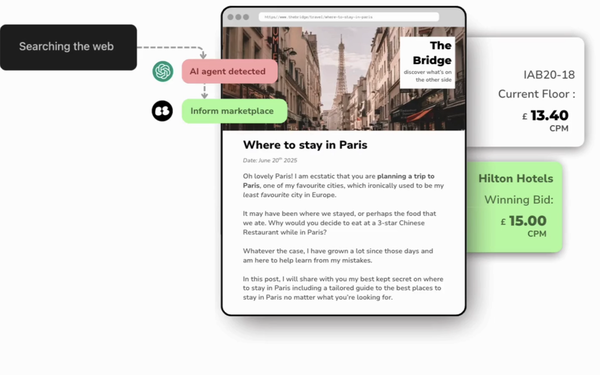
makes sense to me. A company called Blankspace is serving ads to AI agents in real time, right as someone asks a question, almost like a live auction. Consumers ask an agent for hotel recommendations,
and a brand can bid to shape what shows up in the "organic" answer. That one at least touches a real person at a real decision point, which is closer to what advertising is supposed to be.
It's also a little unsettling, because that person has no idea the answer they just got was bought and paid for. If I am running the AI, I can’t let that sponsorship shape the response, or I
risk my response being less than fully accurate. The industry spent twenty years teaching people to spot a sponsored post, and along comes this model that is totally opaque to the end user.
I'm not saying any of this is dumb. Bots are absolutely becoming the gatekeepers of what people see and believe, and there's real value in showing up well inside that system. I just think we're
pricing this stuff like we already agreed on what it buys, and we haven't. Even the people building it will tell you, off the record, that nobody knows if the language models will eventually treat
this as manipulation and start penalizing the sites that do it.
Maybe I’ll come around on this in six months. Maybe someone shows me the mechanism, and it clicks. Right now, an ad served
to a bot still feels like a tree falling in a forest with nobody around to hear it. If there's a dollar in there worth the same as a dollar spent reaching an actual human, somebody's going to have to
explain that to me, not just show me the math behind it. Until then, I keep thinking the real money is in the content sitting underneath the ad, not the ad itself.