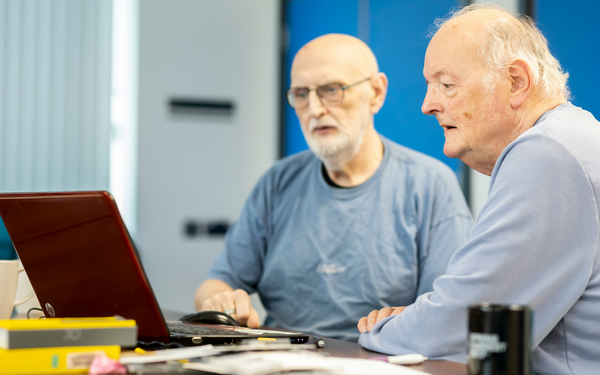
My family is discovering, firsthand, just how
much the world could care less about the elderly.
My stepfather just passed away. He was just a few months shy of his 91st birthday. For the past 10 years, my sister has been
looking after the official side of Dad’s life -- things like his income tax, pension, healthcare and other related needs.
All these services have rushed online, as local service centers
and real, live humans whose job it was to assist their customers have virtually disappeared. The inner workings of these programs lie on the other side of either a website or a call centers. Neither
of these things are designed for the elderly. They are barely functional for any of us, including those much younger than my stepdad.
In the last few years, Dad’s loss of hearing made it
impossible for him to understand someone talking at a normal volume in the same room, let alone someone on a telephone call. This led to him being unable to follow the gist of most conversations.
advertisement
advertisement
My sister, who has the patience of Job, acted as translator and guide for Dad but was constantly flummoxed by bureaucratic rules and privacy regulations that left no wiggle room for the elderly. A
typical phone interaction (usually after waiting over an hour on hold) would go something like this:
My sister: “Hi, I’d like to ask about my father’s income tax return for
2025.”
Phone Agent: “I’m sorry, we can only give information to the person who files the return.”
“He’s here with me. I have his
permission.”
“I’m sorry, I have to speak to him.”
“He can’t hear you. That’s why I’m calling.”
“I need to hear it
from him. Can you hand him the phone?”
“He won’t hear you, but sure, knock yourself out.”
(Dad puts the phone to his ear, having no idea what’s going
on. You can hear the person talking, but Dad just looks at us blankly. My sister takes the phone back.)
“Your dad was unable to answer the security question I asked him to verify his
identity.”
“As I said -- repeatedly -- Dad can’t hear. Can you ask me the question and I’ll ask him?”
“I need to hear the answer from
him.”
“Is there an office we can go to and talk to someone in person?”
“No, all our support functions have moved online. You can use our website. Does your dad
have an online account?”
“My dad has never touched a computer in his life. How would he have an online account?”
You get the gist. These scenarios always played out
along the same lne, but were typically spaced out so my sister had time to regain her incredible patience before the next episode.
But when a person passes, suddenly all these things must be
dealt with right away. My sister's days have been filled with circuitous phone calls trying to tie up Dad’s loose ends, stymied at every turn by the fact that while the system didn’t
support him when he was alive, it’s doubly difficult now that he’s gone.
For the past few decades, technology has enabled companies and government services to offload the effort
required to deliver their services or products from themselves to us, their customers. We now pump our own gas, do our own banking, and monitor our own pensions and income tax accounts. The only
contact we have is either through a woefully designed website (I can tell you the Canadian Revenue Agency’s website is a usability nightmare) or a call center where one-hour waits are considered
the norm.
Most of us, given no alternative, grudgingly jump through the hoops required. We struggle through archaic interfaces, learn new platforms every few years, and constantly have to
reset passwords to sneak past the impenetrable security hurdles of two-step verification. J.R.R. Tolkien made gaining access to Mordor look easy in comparison.
I understand that online fraud
and identity theft is a real concern, but at some point, typically north of the age of 70, it gets harder for us to keep up. As our brains age, they tend to rely more on remembered strategies because
learning something new gets harder and harder. The world used to reward this accumulation of knowledge with age. Now it just kicks it to the curb like last week’s trash.
There are
exceptions, of course. The elderly who are familiar with computers and technology can push the grey digital divide back substantially. But this was not my dad. In his life, he was a farmer, a sawmill
worker and a chimney sweep. None of those things required learning how to use a computer. The world literally passed Dad by. Just how far he was left behind has become acutely apparent to us in the
last few weeks.
Through this all, we keep asking ourselves one very frightening question: If it was this hard for Dad, what is it like for those elderly who don’t have a person
like my sister to help them?
What happens to them?