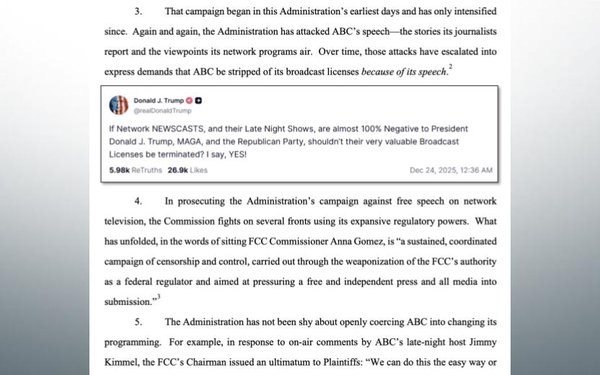
In an exceptionally early renewal process (for
licenses due to officially expire in 2030 and 2031), the Federal Communications Commission has been going after The Walt Disney Co. to strip away ABC's local station broadcast licenses.
That seemingly crazy effort looks to have nearly zero chance of succeeding.
From what many analysts are saying, the FCC is taking this step to shake things up, not
really to take away ABC's broadcast licenses.
Meanwhile, Walt Disney just filed a lawsuit against the FCC's early renewal investigation, citing its
freedom of speech/press rights.
In particular, the FCC seemed focused on news and commentary content, especially for stations airing national TV shows like ABC’s “The
View.”
advertisement
advertisement
The FCC is looking to call a foul on one particular guest on that show, the U.S. Democratic candidate for Texas, state Representative James
Talarico.
“The View” and other general interest discussion shows of its kind have been exempt from the equal time rule for all competing candidates in a
particular race. The time rule traditionally has had a much narrower focus: advertising availability.
For many in the FCC, its chairman Brendan Carr, and President Trump are
all looking to expand this rule to news programming, late-night entertainment shows, and daytime discussion shows.
But is President Trump and his FCC-directed efforts missing the point,
especially considering where younger generations are getting their news content?
Young media viewers -- for the most part-- are not watching much, if any, broadcast/linear TV
content.
“The hyper-focus of the Trump administration on broadcast TV entities demonstrates how stuck in the past the elderly president and his allies are,” says Ross
Benes, analyst for eMarketer. “Generations younger than the boomers hardly watch broadcast networks if sports isn't airing.”
He adds that all this comes when streaming
video services like YouTube and all digital media platforms are not subject to regulation.
Will freedoms of speech and of the press of those more young-skewing outlets be the future
barometer/baseline of where these regulatory/Constitutional arguments reside?