It has been a week of legal fireworks, relevant
to day-to-day marketing management. No, I am not (yet) commenting on the federal trial brought by 29 U.S. states accusing Meta of designing manipulative features that addict children and harm teen
mental health on Facebook and Instagram. That trial is underway in the U.S. District Court for the Northern District of California in Oakland.
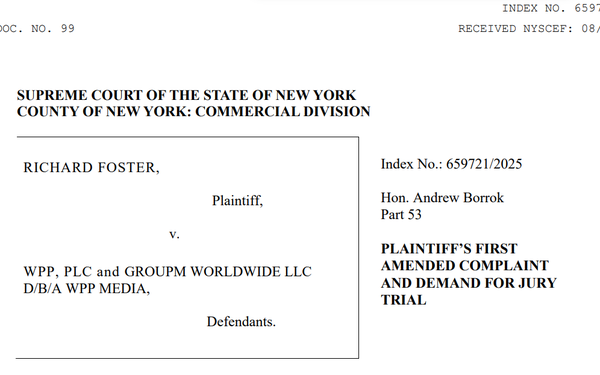
I am talking about Richard Foster's $100 million
wrongful termination and retaliation lawsuit against WPP, playing out in the Supreme Court of the State of New York.
The latest legal filings in this suit against WPP make for grim reading. Internal audit details from Sony allege undisclosed markups, shell
brokers used as financial warehouses, and missing rebates disguised as principal media buying in China,
advertisement
advertisement
To understand the scope, let’s understand what happened. A 2023 Chinese government
probe into GroupM (now WPP Media) executives over kickbacks led to criminal convictions. And now we learn that a Sony investigation alleges that WPP used 47 shell brokers to improperly retain $350
million in client rebates in 2024 alone. GroupM allegedly passed off proprietary media deals to launder those funds into corporate profit while pitching artificial "80% discounts" to clients.
I don't think you can hold WPP corporate fully responsible for the rogue mechanics of a local scam. The individuals in China clearly acted for their own personal enrichment in a market where
opacity is sadly often standard procedure.
Still, WPP corporate does not get off scot-free. It clearly missed the mark in governance. By aggressively pushing principal media trading across its
network to juice corporate margins, WPP’s leadership set the tone at the top. They created an environment where local executives were guided into pursuing principal media income to bolster
agency performance (and with that, their personal performance score).
If I were a juror on the Foster case, I’d view the Sony findings as a crucial signal. They show WPP built a culture
where principal-beneficial buying was incentivized, leaving the back door wide open for local leadership to take it to extreme levels.
Which raises the question every marketer should ask: How
many other "Chinas" exist in agency holding company networks? And why did it take a client audit by Sony to expose this?
It’s is fair to say (again) that marketers should stop treating
principal media as a harmless discount. When your agency buys inventory upfront and resells it to you, they aren't your fiduciary agent anymore. They're a vendor selling goods they own. If you
don't know the exact markup, you're funding their profit margins (and executive bonuses).
To prevent this from happening, you should require explicit opt-outs for proprietary or
non-transparent media ,unless your C-suite approves a written business case. Demand clear visibility into media flowcharts and mandate proof-of-performance data down to a detailed performance level
(and compare/contrast that against “normal” performance for “normal” paid media buys).
Don't rely on agency self-reporting. Demand log-level data for programmatic buys
and contractually insist on third-party audits for all barter or non-transparent arrangements. If an agency claims an inventory pool isn't auditable, treat that as a red flag.
The agency model
is shifting. Agencies need profit, but you need transparency. Set the rules in your contract now, or your media dollars will end up paying someone else's bonus.