The
following is a pre-publication excerpt from Terry Young's new book, "Possibility Sciences: A Discipline for Turning Bold Ideas into Reality,"
which will be published in November. Young, who founded Omnicom's now defunct,
but innovative cultural intelligence consultancy, Sparks & Honey, has an exponentially ambitious new project, which is also profiled here.
We have more tools, knowledge, capital, and imaginative capacity than any
generation before us, yet many of our boldest possibilities still struggle to become real.
advertisement
advertisement
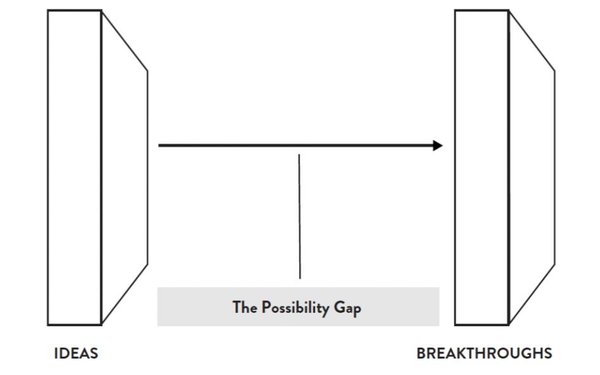
The widening distance between what we can imagine and what our systems can deliver is what
we call the Possibility Gap.
The machinery of modern innovation never stops humming, yet most of it circles the territory we already understand. Somewhere along the way, we
started confusing constant motion with meaningful progress. Beneath the dashboards, demo days, and hackathons that epitomize modern management lie deeper operating reflexes built for efficiency rather
than exploration. They emphasize short-term incentives, establish work boundaries with silos and turf, and reward efficiency and extraction over exploration.
Corporate, venture, and
political clocks all pull ambition toward the near term. Leaders learn to favor reversible decisions and incremental features because the wider system stifles bolder, longer-term vision. Foundational
research, shared standards, and public infrastructure do not languish because no one believes in them. They languish because their returns arrive on the wrong calendar. We have, in effect, built a
civilization that can mobilize quickly for what is urgent but rarely for what is important.
There was a time when “fail fast” meant learn fast. In many places I
encounter, it has come to mean something else: minimize exposure. The lean startup ethos, created to support early experimentation, has solidified into a culture of microvalidation. Build, test,
pivot, repeat. It rewards incremental improvement and penalizes expansive exploration. The discipline of scaling efficiently has replaced the art of imagining boldly. The result is a surplus of
optimization and a shortage of imagination. We have optimized our way into a corner where the next A/B test matters more than the next audacious question.
This is the crisis of
innovation: a system that keeps making the known cheaper while underinvesting in what would make the unknown possible. Each year the world invests trillions of dollars in research, technology, and
innovation, even as we gain unprecedented access to computational power. By any rational measure, this should be the most generative moment in human history.
Instead, much of that
spending reinforces the reflex of optimization. It fuels clicks, engagement metrics, and ad engines, while the work that could genuinely transform civilization remains structurally underfunded. We
finance distractions at scale while the deeper civilizational dreams of unpolluted air, regenerative cities, and affordable longevity wait in the wings, undernourished and half-acknowledged.
The boldest ideas remain as dreams in people’s heads and notebooks, admired in principle but unfunded in practice. This is the Moonshot Paradox: At the very moment when we have the
most capital and computational power in history, we have quietly dismantled the architectures that allow those dreams to take root as real moonshots.
History shows that it has not
always been this way. Societies have built architectures of imagination before. The Apollo Program, the Human Genome Project, and the early internet weren’t accidents of genius; they were
deliberate collaborations across government, academia, and industry, anchored in shared purpose and patient timelines. They reveal periods when imagination functioned as infrastructure rather than
individual inspiration, supported by systems designed to expand capability, distribute risk, and ensure that breakthroughs compound rather than stall.
That is the central paradox of
our age: We celebrate moonshots rhetorically while dismantling the very systems that make moonshots possible.
It has never been easier to picture the future. We can sketch
regenerative infrastructures, precision health systems, resilient democracies, and off-earth settlements with astonishing ease. But the machinery that should move these visions into the world too
often slows them to a crawl.
It is in this widening space that dreams accumulate with no reliable bridge strong enough to turn them into reality.
Closing the
Possibility Gap requires more than vision. It demands new rails for imagination: infrastructures that preserve what is learned and institutional architectures capable of helping communities,
companies, and governments turn imagination into implementation with coherence across time.
History offers clear evidence that sustained, publicly and privately supported imagination
compounds into enormous value. Each breakthrough can become the seed of thousands more.
Environments that reward overlap, impose intelligent constraints, and formalize remixing
produce compounding progress. They are the test beds where small experiments become large systems.
This is where Possibility Sciences begins. Humans have always been able to imagine
possibilities. What we still lack are the shared systems that allow societies to explore what comes next with rigor, continuity, and scale: systems where possibilities can be simulated and their
consequences explored, where breakthroughs generate spillovers that expand what others can build, and where knowledge and capability compound rather than reset.
That is the missing
architecture at the heart of Possibility Sciences.