Editor's note: This column has been
updated from the original version, which misidentified Frank McCourt.
On weekday mornings you can find me in our kitchen making breakfasts and lunches for my wife and daughter
while listening to the offerings from TuneIn radio on my Amazon Echo Show device. After CNBC, I’ll often listen to what CNN has for the day. Lately, they’re running a show called "Terms of
Service" that includes Clare Duffy interviewing Frank McCourt.
It’s a terrific interview that talks about some great topics including a future where A.I. agents replace apps. I
highly recommend it.
At first, I thought Frank McCourt was the same guy who wrote the amazing memoir called Angela’s Ashes. It came out in 1996 and won a Pulitzer Prize.
However, that Frank McCourt passed away in 2009.
advertisement
advertisement
According to Wikipedia, this Frank McCourt made a lot of money as a real estate developer in Boston. In 2004, he purchased a
controlling interest in the Los Angeles Dodgers from Fox Entertainment Group which was owned by Rupert Murdoch’s News Corporation. CNN calls him a billionaire investor.
More
recently, McCourt is the founder and executive chairman of Project Liberty, an initiative aimed at creating a new, equitable internet infrastructure. Together with Kevin O’Leary (a.k.a., Mr.
Wonderful), they were partners in the “People’s Bid” to buy TikTok’s U.S. operations. Their plan is to replace its algorithm with one that gives users control over their
data.
He’s obviously an amazing person but I disagree with him on some of his views about data. McCourt believes that it’s a really bad deal for people to give up all
their personal data for free apps. He believes it’s fundamentally wrong for these platforms to own our data. He thinks we should own our own data and share it on a permission basis.
In the interview, McCourt says Project Liberty has hired amazing technologists and have been building an alternative to current internet platforms that gives individuals more control. The
challenging part, he says, has been how to get people to adopt it.
McCourt goes on to say that when the news came out that the U.S. wanted to ban TikTok and sell it to U.S. buyers
without the algorithm, it was very “serendipitous,” because his team had already built the technology that could replace it. They would be able to buy TikTok, sans the algorithm, and
simply move the 170 or so million users over to their new technology stack. He said it would solve a national security problem and spin up an alternate internet. This is why he and O’Leary
entered the fray and put forward a bid that would qualify under the legislation.
Unfortunately for McCourt and O’Leary, the deal went to another party. According to CNN,
they’re investigating if the alternate deal complies with the sale-or-ban law passed last year and whether it addresses the national security concerns behind the legislation.
This is all interesting on its own, but what I want to discuss is the popular premise behind McCourt’s comments on CNN that “it’s a really bad deal for people to give up
all their personal data for free apps.” I don’t know that he’s done the math.
As a former business development person for many years, I’m always interested to
learn the numbers behind the businesses. How do they make money? I find it so interesting.
Let’s use Meta as an example. According to a Meta press release, the company had a
net income of $62.36 billion in 2024. This is for its entire company, including Facebook, Instagram and Messenger.
During the same year, Statista reports the combined number of daily
active users (DAU) for Meta platforms was 3.65 billion.
If you divide Meta’s income by its number of users, it amounts to $18.61 (62.36/3.65=18.61). If you were to do the same
calculation based on subscribers instead of users, it comes out to $15.59 (62.36/4=15.59).
It simply isn’t true that peoples’ data is very valuable to them personally and
that these technology companies are exploiting them by harvesting and using their data.
For about the same price as one dinner at Chipotle, Meta subscribers can use all of
Meta’s platforms every day, 24 hours a day, for 365 days a year with no blackout periods. If you ask me, that’s more than a fair deal. In fact, it’s fantastic.
The
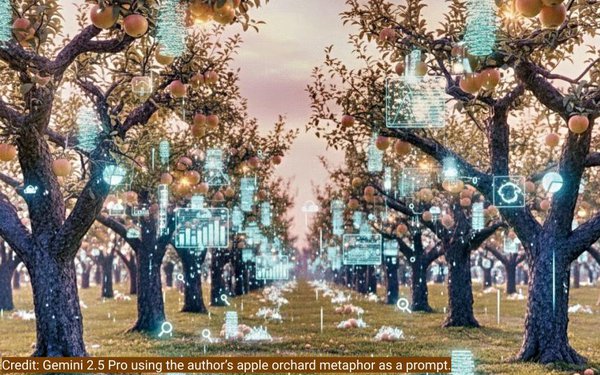
whole idea of your data being yours sounds a little ridiculous to me. If the people using Meta’s platforms were apple trees and Meta was a farm that produced apples, would the apples belong to
the trees (people) or the farmer (Meta) that harvested them? If it were a farm, the apples would belong to the farmer and not the trees.
Speaking of harvesting, who do you know that
takes the time or even has the means to harvest their own data? Yeah, try writing down every website you go on, start and end time, length of view, URL and everything that goes with it. The answer is
simple: no one. The only reason we’re even having this discussion is because these platforms are doing the harvesting on our behalf.
I guess you could argue that the platform
doesn’t own the people the way that the farmer owns the trees, but either way the value of data to an individual is negligible and it’s inaccurate to say that free apps are a bad deal.
They may have other issues as it relates to privacy and the way they manipulate people to increase usage, but they’re not a bad deal, at least not from a financial perspective.
While I don’t agree that everyone’s data is valuable to them individually, I do love the idea that people make money from their user-generated content, but I think that’s a
separate conversation and not the one that McCourt is advocating. Maybe, it’s mixed in there somewhere and I’m just not privy to the whole plan.
Frank McCourt and Kevin
O’Leary are obviously great investors, extremely smart people and I believe that they have good intentions, but I think it’s inaccurate to sell their proposal by telling people that free
apps are a poor bargain.