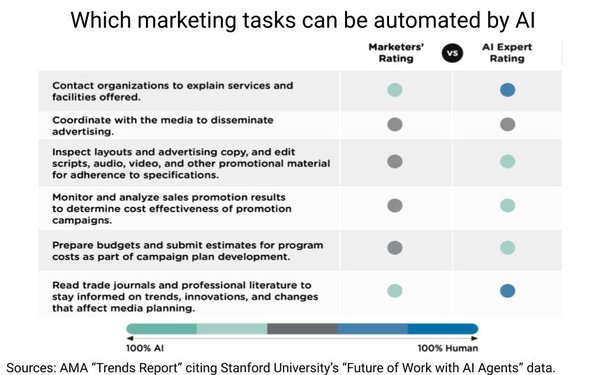
The good news for "Media 3.0" and other
MediaPost publications -- as well as our peer trade publishers covering media planning and buying -- is that artificial intelligence (AI) experts don't anticipate our human readers being replaced by
AI agents anytime soon.
The bad news is that an even more important constituency for us -- human marketers themselves -- do anticipate much of their trade publishing reading will be delegated
to AI agents.
If you're an AI agent already reading this column, feel free to leave a comment below. Humans are welcome to too.
Either way, it's something I think about a lot these
days, knowing how my own behavior has begun to change in terms of how and what I read -- and how much I have begun delegating some of it to AI.
Case in point: In the past 24 hours since
receiving an advance copy of the American Marketing Association's just-released and first-ever "Future Trends In Marketing" report, I immediately uploaded the 92-page tome into NotebookLM because, you know, TL;DR -- but also because I was curious how an LLM would
break down and distill the main takeaways.
advertisement
advertisement
As I often do, I also asked NotebookLM to generate a short audio overview of the report for those of you who don't like reading much of anything at
all.

And for those of you who don't like listening either, I asked it to
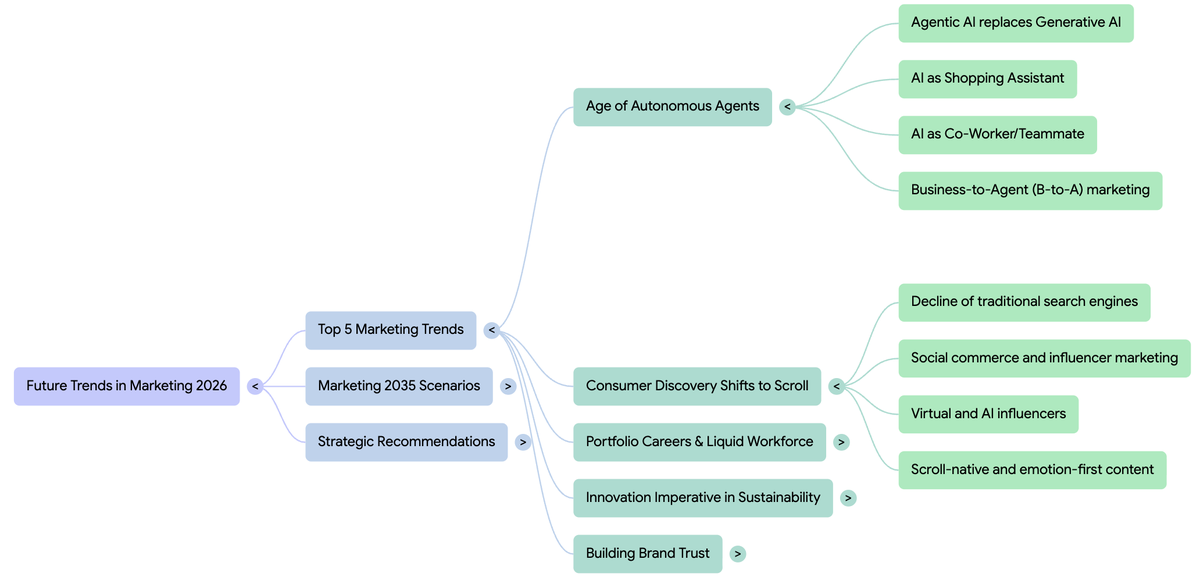
generate a "mindmap" delineating the thinking behind the report, branching out what the AMA told me were the two top of Big 5 trends addressed in the report: the "Age of Autonomous Agents;" and
"Consumer Discovery Shifts To Scroll."
I
recommend that you read the report in its entirety, because it is both highly relevant, and utilizes an interesting melange of methodological components to come up with its trends, as well as a series
of year 2035 scenarios depicted at the end of the report. You can read about the methodology in the report, but it basically combines a panel of industry experts, as well as some AMA-grade third-party
academic sources, including Stanford University's "Future of Work with AI Agents" that I clipped in the chart at the beginning of this post.
Aside from impacting the possible future of ad
trade editors, reporters and bloggers, as noted in my lead, the study provides an interesting analysis of what two different types of experts -- both human ones, I might add -- think about the future
of marketing-related work: experts on AI and experts on marketing.
Interesting, other than using AI to read trade pubs and using the technology to contact vendors in their supply chain,
marketers are much less sanguine about using AI for other important marketing tasks, including coordinating with media to execute ad campaigns.
That one surprises me, given all the coverage we've been devoting to the rapid acceleration of agentic media-buying applications and platforms.
But I also think it's heartening that human marketers believe they will continue to have direct relationships with the media, even if it's not with B2B trade publishers who report on it.