-
by Dan Perry
, Op-Ed Contributor,
January 2, 2026
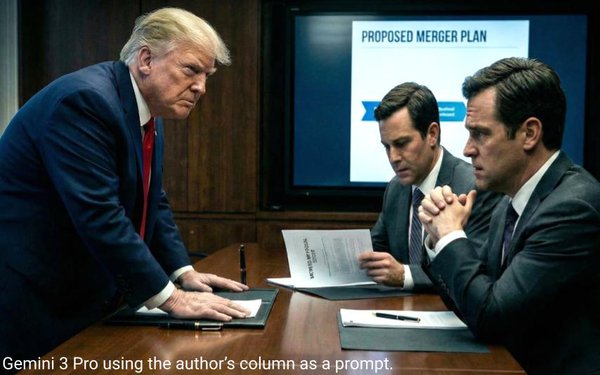
The Trump administration has discovered
a nifty new trick: It is using federal merger authority to pressure news organizations into compliant coverage. The parent companies of CBS and CNN are being subjected to regulatory leverage that is
slow and opaque, and therefore suited for political coercion. What appears to be procedure is actually a protection racket.
This madness is related to the other major Trump
innovation: his team of disruptors has discovered that in modern America, actions do not have to be legal in order to be effective. It only needs to move faster than the courts. An unlawful executive
action can remain in force for months or years before a final ruling arrives. During that time, markets adjust, companies comply, executives adapt, and political objectives are often achieved by the
time a court intervenes.
advertisement
advertisement
The crown jewel in this scam is the global tariffs that clearly exceeded statutory authority, have been challenged in courts, and are currently before the
uber-friendly Supreme Court. Meanwhile they have reshaped supply chains, pricing, and trade behavior.
The whole while Trump is lying to the American people that the tariffs,
which are paid by American importers and consumers, and bringing in fabulous sums of money from abroad. The only way to counter such falsehoods is via the media calling them out and explaining
how tariffs really work – where is where shaking down the media comes in.
And in aid of that, the government’s role in merger approval is a gold mine. It is procedurally
complex but amounts to a way to govern industries — media, technology, telecommunications — that are heavily leveraged and thus vulnerable and dependent on regulatory permission to
survive. It’s an ideal instrument of coercion.
Let’s look at what’s actually going on.
In the case of CBS, the pressure has already produced
concrete outcomes. After President Trump sued CBS and its parent Paramount Global in late 2024 over a 60 Minutes interview with then–Vice President Kamala Harris — a lawsuit legal experts
widely described as frivolous — Paramount agreed in mid-2025 to pay Trump $16 million to
settle the case as it sought approval for its planned merger with
Skydance Media.
The payment, which will go to Trump’s future presidential library and legal costs, came amid internal turmoil at CBS, the ouster of senior news
executives, and widespread alarm among journalists that editorial independence was being compromised to smooth the path for regulatory approval. This week, CBS abruptly pulled a high-profile 60 Minutes investigative segment on Trump’s deportation policy just
before broadcast, citing editorial concerns — though critics said the timing and context strongly suggested political conditioning of coverage tied to the same merger dynamics.
For CNN, the pressure is unfolding through the battle over Warner Bros. Discovery, its corporate parent. Trump has publicly intervened in the sale process, declaring it “imperative that CNN be sold” and favoring bids connected to allies over
others, at the same time his administration’s regulatory review looms over competing acquisitions of Warner assets. Paramount’s bid for Warner, which would bring CNN and CBS under the same
politically connected ownership, has raised concerns that editorial leadership and programming at the news network could be reshaped in line with Trump’s preferences.
The
brazenness would be shocking, if anything were still shocking.
CBS and CNN are being targeted because they are exposed. Their parent companies are heavily leveraged, dependent on
scale, and in need of regulatory permission to restructure their businesses. Trump’s allies at the Federal Communications Commission and the Federal Trade Commission raise
“concerns,” float objections, delay reviews, and question whether license holders are acting in the “public interest.” The language remains procedural but it’s a
Putinization plan all the same.
In theory, antitrust review is technocratic. In practice, under Trump, it has become transactional. Companies are no longer judged only on market
concentration or consumer harm. They are evaluated on whether they present a political problem to the White House. The question is no longer whether a merger complies with antitrust standards but what
the merging parties are prepared to offer. For media companies, it’s a shakedown.
We have already seen the run-up.
When administration allies openly
discussed using FCC licensing authority to pressure broadcasters over Jimmy Kimmel, it was not a serious legal argument but a stress test. It somewhat worked. Stations briefly pulled the show because
they understood the cost of resistance. But days later the show returned by popular demand.
The same principle governs White House and Pentagon access. Press credentials, pool
access, and briefing invitations are administrative privileges, so Trump has exploited that gray zone relentlessly. Outlets that cooperate receive access and proximity. Those that do not are frozen
out, mocked, or delegitimized.
The farcical “Gulf of America” episode was instructional. The administration fed absurd terminology into official channels and watched
which journalists complied. Coverage became a loyalty test.
This is how authoritarian systems can evolve inside seemingly mature democracies: through selective imposition of
inconvenience and penalties. The press is exhausted, pressured, and economically weakened until self-censorship feels like prudence. Merger coercion is a very effective variant of that logic.
Unlike access disputes or licensing threats, mergers are existential. A blocked transaction can destroy shareholder value, remove executives, and collapse companies already carrying enormous
debt. Because mergers are slow, opaque, and discretionary, they offer perfect deniability. Every denial can be framed as regulatory concern. Every delay can be framed as due process.
We should not be fooled. Banana republics rule through crude patronage and overt corruption. Putin’s Russia rules through brutal enforcement and oligarchic dependency. Trump’s
America is becoming a hybrid system in which formal legality remains intact while outcomes are determined by political favor.
In this system, CNN does not need to be nationalized.
Its parent company only needs to believe that independence is too expensive.
As the number of news organizations shrinking, each remaining outlet carries disproportionate weight.
This is why CBS and CNN matter even to those who never watch them. Their weakening sends a signal to every editor, producer, and publisher downstream.
Today it is media mergers.
Tomorrow it will be defense contractors, technology platforms, universities, or financial institutions. Any entity that requires permission, approval, or tolerance from the state becomes
vulnerable.
In my travels as a foreign correspondent, I have seen authoritarian states. The government does what it wants, and usually enriches its members before they need to flee
the country. It is a not a good system. You do not want to live there.