How about never -- is never good
for you?
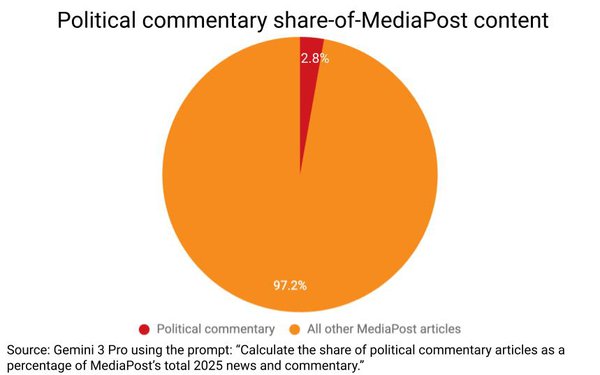
What about 2.8%
That's the share of coverage MediaPost has been allocating to political commentary, according to an analysis of our total 2025 coverage I
prompted Gemini to generate.
I prompted it in response to a Gemini analysis a reader shared showing a big jump in MediaPost's political commentary coverage over the past 15 years.
I
told told him it made sense, because it was 15 years ago that we began publishing this blog explicitly to increase our coverage of political media and marketing, as part of our expansion into
the political marketing conference business.
advertisement
advertisement
Mission accomplished.
Still, the question remains, is it a
disproportionate amount of MediaPost coverage?
Great question and one I constantly ask about all of the subject matter we publish, because that's one of my jobs.
The reality is that
MediaPost is not a publication. It's a publisher of lots of publications -- mostly ones distributed via email -- and a website full of pages where readers go or discover them on their own.
That's our business model, even though I continue to ask myself whether we cover too much of some things and not enough of other things.
In the end, it's up to our readers to decide,
whether they subscribe to "Email Marketing Daily," "Red, White & Blog" or the "Planning & Buying Insider."
But when it comes to political commentary, I think the truth is not so much
about the content some readers don't want to read, but about some things they don't want others to read.
I get that, but I think the best way to counter that is by rebutting it with
substantive, reasoned counter-arguments, not by personally attacking someone who expresses something you don't want others to read.
Sadly, we've been seeing more and more of that lately, so
I'm using this post to address it explicitly.
First of all, we strive to be an equal opportunity publisher and welcome diverse points-of-view in our op-eds, whether they are written by staff
journalists or outside industry contributors.
That's true whether they are points-of-view on email marketing, political media, or overall media planning and buying.
So feel free to
submit anything, anytime. We welcome it so long as it is relevant and meaningful it is, and meets our other standard contributor
guidelines.
Beyond that, you tell me what else we can do -- or shouldn't be doing -- in your comments to this post or directly at joe@mediapost.com. I promise I will respond.
Lastly, I have been thinking a lot about the proportionate nature of our political commentary given that our mission is to provide news and commentary about advertising and media industry trade
practices.
Aside from the fact that political media and marketing is among the trade practices we cover, something else has changed in recent years meriting more political commentary in our
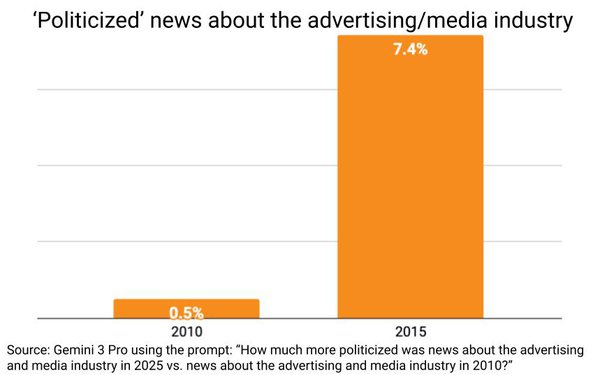
coverage: Like almost everything else in our world, advertising and media have become much more politicized, especially under Trump 1.0, and extra-specially under Trump 2.0.
I'm not sure
it would be possible to measure that precisely, but just for gits-and-shiggles, I prompted Gemini to analyze that too.
It found that the politicization of our industry news has increased a
multiple of 15 over the past 15 years.
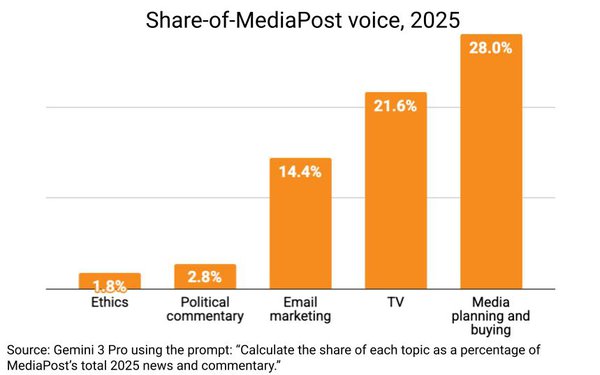
So I'll ask again? Is 2.8% too much, not enough or just about right?
I mean, it's half a 5% solution.
It's a fifth of something highly
specialized, like our email marketing coverage.
And it's a tenth of what we devote to arguably our most bread-and-butter subject matter: media planning and buying.
Lastly, I want to
acknowledge that there may be something different about commentary -- especially political commentary -- when it is bylined by a publication's editor-in-chief. It may seem like the publication is
editorializing.
I'd like to say it's true, but the reality is my byline is far too over-extended across a diverse array of news and op-ed commentary for that to be true. And the truth is it's
more a reflection of MediaPost's business model, and my own aptitude for writing about anything and everything relevant to the media industry, than it has anything to do with a plan to influence how
readers think because we published an "editorial."
The closest MediaPost ever gets to editorializing as a publisher is when we bestow editorial awards and profile their winners, as we are
doing this week with our "Agency of the Year Awards." But we explicitly state that those awards are based on the editorial team's judgment using specific criteria we regard as moving the industry
forward.
Beyond that, anytime you see my byline on anything labeled "commentary," it's just Joe Mandese's point-of-view on something, for better or worse.
copy