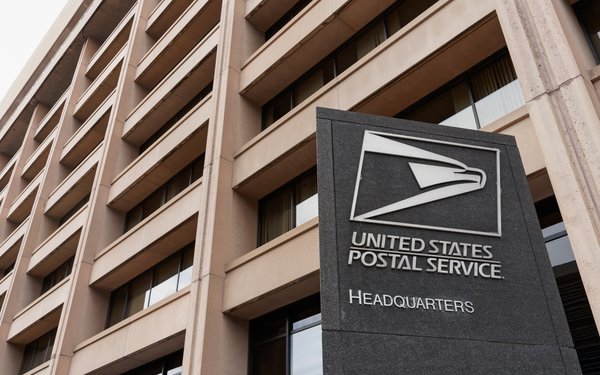
The U.S. Postal Service (USPS) is on its last legs
again, judging by comments made at a Congressional hearing on Tuesday.
Each year, the USPS “loses billions, and in 12 months they will run out of cash,”
said Pete Sessions, U.S. Representative for Texas's 17th congressional district, who is chairman of the Subcommittee on Government Operations, in an opening
statement.
Sessions added, the “time for major change is now.”
Postmaster General David Steiner reinforced that point by
saying: “In about a year from now, the Postal Service would be unable to deliver the mail if we continue the status quo.”
What to do beyond cutting
delivery to five days a week and closing post offices?
advertisement
advertisement
“One easy action, increasing our borrowing authority, buys us time,” Steiner said. “Time that we can use to best
determine what the Postal Service should do to best serve the American public.”
Steiner also asked for authority to raise postage rates.
“At $0.78, the U.S. first class
stamp is the lowest in the industrialized world,” the PNG said. “Compare it to France at almost $3 and England at $2.50, and the longest distance those letters have to travel is
about 600 miles smaller than the state of Texas. We deliver from the tip of Puerto Rico to the tip of Alaska for $0.78. That’s a distance of 5000 miles.”
Steiner continued,
“If we were to change the stamp price to $0.95, which is still less than half of the cost of foreign posts, that would largely solve our controllable loss, and the stamp would still be the
lowest in the industrialized world by a lot.”
It sounds reasonable, but one must ask: Would the USPS also raise publication rates to get out of this mess? That could have a serious
impact on magazine and newspaper publishers that rely on the USPS to deliver their periodicals.
Take USA Today Co., the former Gannett, which has been winding down its home delivery services
and mailing newspapers -- often with reduced frequency, via the USPS. Lee Enterprises has been taking a similar course.
"Since August 2021, even with a price cap in place, news and
magazine publishers are seeing price increases that are 254% above the rate of inflation, which at that level is unsurprisingly leading many small, local newspapers and magazines to cut staff, shutter
titles, or close their doors entirely," says Danielle Coffey, president and CEO of the News/Media Alliance."
If this trend continues, this will mean less news and information ending up in the
hands of local residents, and fewer publishers able to stay afloat to continue delivering through USPS. We ask Congress to help stop the bleeding from USPS’s outrageous rate increases that are
doing more harm than good.
On another front, Amazon plans to reduce the volume of packages it ships via USPS by two-thirds before this fall when its contract runs
out, The Wall Street Journal reports.
Given that it shipped more than a billion packages last year -- 15% of total USPS delivery volume, making it the
largest single user of the USPS -- that would ruin the post office as it stands now.
Assuming this is all true as stated and that it is not being exaggerated to scare Congress into
funding it. How did the USPS end up in this state?
Of course, we can blame the sheer antiquity of the institution, and the decline of paper mail volume.
Steiner himself said the
USPS got here “because of the drastic reduction in the use of the mail, from historic peak volume of 213 billion pieces per year to today at 109 billion pieces per year.
[USPS] lost over 104 billion pieces per year in [its] system.”
He added: “For perspective, if all of that lost volume was paid at the current price of a stamp, which is $0.78,
that’s about $81 billion of lost revenue. No company could weather that much revenue loss, so it’s not hard to see how we got here.”
True enough. But there is
one other stakeholder that deserves a voice in this debate: The American Postal Workers Union, which may know the real story.
In fiscal year (FY) 2025 alone, more than 70% of USPS
losses resulted from factors outside of its control, including limited access to traditional financing and restrictive investment requirements for pensions and retiree health care.
This
highlights the need for financial reform, the union said, citing in part a recent analysis by Roman Martinez, a former Postal Board Governor, of a report published by the Office of the Inspector
General (OIG).
The current law requires pension and retiree health benefit funds to be invested solely in Treasury debt. Martinez, citing the OIG report, says that if those funds had
been invested in a traditional portfolio like other independent agencies, such as Amtrak or the Tennessee Valley Authority, are allowed to do, they would have shown an $800 billion surplus instead of
a $100 billion deficit at the end of FY 2022.
It continues: “Additionally, when the Postal Service became independent in 1970, responsibility for funding pensions of employees who worked
for the old Post Office Department was unfairly distributed, according to the OIG. This created an annual payment mandate from the Office of Personnel Management to reduce the pension fund
deficit.”
That’s where the real blame lies, and it's up to Congress to correct it.
Coffey adds, "While we understand the financial distress facing the Postal Service
and are supportive of the Congressional reforms that USPS has outlined, these reforms must be implemented in tandem with lower rates. Many of our members depend on the postal system - especially rural
and suburban newspapers and magazines that require national distribution, but the frequency and amount of postal rate increases is unsustainable, posing an existential threat to many local publishers.
News publishers are already under serious threat due to significant loss of advertising revenue to Big Tech - rising print and delivery costs leave them with few options to continue delivering the
critical news and information that Americans want and need."
We're sorry to say it, but if history is any guide, we don’t expect much beyond a band
aid to help the USPS get through this crisis.
This story has been updated.