Commentary

Nielsen: Move Along, Nothing To See Here (*)

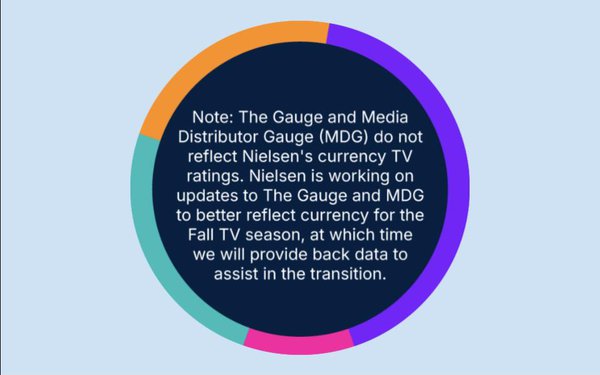
Nielsen finally released February data for its monthly "Gauge" report and the numbers, as expected, showed streaming's continuing dominance over broadcast and cable TV. In fact, the only real news was a footnote Nielsen added to the bullseye inside the monthly Gauge graphic (see above).

In other words, the data Nielsen continues to publish -- and which it delayed today's release by a month for -- isn't actually representative of how Americans watch TV across platforms.

Or put yet another way: Nothing to see here, move along to next fall when Nielsen releases recalibrated data it says will actually be representative of how Americans watch TV across platforms.

Personally, I don't know why Nielsen is releasing monthly Gauge data until it actually is representative, because it seems like it does more harm than good by confusing the marketplace with data based on a methodology it knows to be incorrect, but at least Streamers look good in the meantime.

advertisement

advertisement

I mean, it's the same knock I gave Nielsen when it released an "Upfront Planning Guide" last month that was also based on an old methodology that will not be the numbers upfront planners and buyers will be using as the basis for the upfront they are actually buying, or will be posting off of next season.

It's not just tone deaf. I think it constitutes willful disinformation, propagating information in a commercial marketplace known to be factually incorrect.

If Nielsen were publicly-traded, which the private-equity owned researcher currently is not, it would be in violation of Securities and Exchange Commission rules and subject to shareholder suits for doing that.

In journalism, continuing to publish information known to be harmfully inaccurate would be a potential liability.

Not so in the advertising marketplace, where willfully perpetrating knowingly misrepresentative data is, well, business as usual.

Ah, but at least there's a footnote, right.

7 comments about "Nielsen: Move Along, Nothing To See Here (*)".
Check to receive email when comments are posted.
  1. Ed Papazian from Media Dynamics Inc, April 14, 2026 at 12:49 p.m.

    Joe, no "audience" survey can legitimately claim to be absolutlly and accurately representing anything--like what Americans watch on TV--and Nielsen is no exception. All that can  be claimed is that statistical steps were taken to make the sample more closely resemble what other evidence suggests the population measured looks like demographically and, in this case, by CTV penetration, cable access, etc. As for the actual findings, we don't know if the old people meter panel or the new "big data" plus people meter system is putting out "correct" data. One can only hope --and so far nobody has stated otherwise---that whatever source is used to estimate what people are "watching" is doing so on a fair basis and not unduly favoring one seller over another. 

    The basic point is that advertisers who buy linear TV  ad time will never get a census-like reading of their "audience". And linear TV now accounts for about 80% of all "TV " ad "impressions".As for CTV, yes, it's technically possible to determine how many devices presented a commercial on their screens and, within  reasonable limits  where these devices are located geographically. But that's about all. We don't know if any one was present at a given moment nor, if so, whether they were paying any attention. 

    So why all of the fuss?

    Because the streaming is "the future" folks have siezed upon The Gauge as a propaganda asset --which is fine with me. But it is not, nor was it ever intended to be a media planning or buying/selling tool. It's much too simplistic and general in nature for that. So Nielsen has a valid point, though I think it erred by not being ready with a historical retab of The Gauge viewing shares when it decided to make the switch to new universe estimates.

  2. Joe Mandese from MediaPost Inc., April 14, 2026 at 1 p.m.

    @Ed Papazian: While the first part of your comment is definitely true, in this case, Nielsen is knowingly publishing data it knows is not accurate and misrepresents what it is giving clients now (in the form of impact data so they can make upfront planning estimates) and what they will be publishing as actual "currency" beginning this fall. They are willfully publishing data they know is not representative of the marketplace, but which happens to benefit streamers in the meantime. Read into that what you want.

  3. Ed Papazian from Media Dynamics Inc, April 14, 2026 at 1:28 p.m.

    Joe, to my knowledge, Nielsen is not knowingly producing "innaccurate" data, nor is it misrepresenting what it is providing to its clients.

    Any advertiser who makes upfront buying plans based on the kind of general data provided by The Gauge---revised or as is--is a total babe in the woods and is desperately in need of professional media expert help.

    Also, switching to somebody else's universe estimates does not make the resulting "new" data more or less accurate. We must eventually face reality about audience surveys--and that applies for all media, not just national TV. These are estimates, subject to unknown degrees of error both as to the amount of viewing, reading, listening, etc and, far more important, how whatever is found is split up among the sellers. So lonng as the latter is not in question, we are spinning our wheels. 

  4. Joe Mandese from MediaPost Inc., April 14, 2026 at 1:30 p.m.

    @Ed Papazian: For your knowledge... 

    https://mediaratingcouncil.org/sites/default/files/News/MRC%20Releases%20Update%20on%20the%20MRC-Accredited%20Nielsen%20National%20Big%20Data%20%2B%20Panel%20Television%20Service.pdf

  5. Joe Mandese from MediaPost Inc., April 14, 2026 at 1:52 p.m.

    @Ed Papazian: Also for your knowledge: 

    https://www.wsj.com/cmo-today/nbcuniversal-says-nielsen-devalues-media-companies-with-inaccurate-metrics-d2490068

  6. Ed Papazian from Media Dynamics Inc, April 14, 2026 at 2:35 p.m.

    Thanks for those links, Joe. I've noted both articles before--but it didn't hurt to reread them. 

    My problem with all of this is that I've seen the same thing in the past, though not in the frenzied scale of this campaign to discredit Nielsen. And, as I keep saying, nobody, certainly not Nielsen, can claim that it is putting out 100% "accurate" estimates. All that can  be claimed is that it is providing a reasonably even handed picture of how the TV audience is probably divided by seller, in show by show detail.

    Unfortunately,  many people seem to think that Nielsen is purporting to tell advertisers almost exactly how many people--and what kinds of people ---"watched" their commercials on each TV show. And the data is presented in exactly that way as "we" have pushed Nielsen to provide "granular"data when it's system isn't capable of doing so. In other words, "we" have asked too much and "we" have become overly reliant on the "ratings" as if they, and they alone, are why advertisers use "TV". That's not the case. Indeed were it determined, somehow, that the TV "audience" numbers were vastly overstated--as was found with radio when it made the switch to PPMs from diaries----advertisers who are wedded to TV would probably increase their ad spend, not decrease it, in order to get the coverage they thought they had been getting. But try to sell that idea to a sales guy. LOL. 

    What really astounds me is that advertisers are total no shows on this and the agencies are, to put it mildly, being very passive. Which leaves it almost exclusively to the sellers and their alles to fight the battle against Nielsen. But what are they offering, instead? Which alternative source is being touted as a replacement--with the promise of "better", and BTW,
    "higher" audience estimates? 

    And which new methodology would the sellers support if it included a true measurement of whether people actually looked at the screen on a second by second basis and didn't mute the sound? That's what's needed, not just a much larget set usage sample in order to get "stable" ratings for every show. 

  7. John Grono from GAP Research, April 14, 2026 at 8:24 p.m.

    Very interesting.

    I came across an example of poor 'audience and advertising' claims back here in AU.   One of our larger sports had made a claim that Australian Rugby League in the first 4 weeks of the new season that '25 million people' had watched Rugby League.

    That claim made me chuckle that given in a country of 28 million it means that 90% of Aussies have watched footy in a month.   A couple of million would make sense .. not the claim.
      
    They probably tallied the 8 games of each of the 4-weeks up to then (be it attendence, TV, radio, internet etc.) and probably didn't take into account that watching/listening for a few seconds accounted equally to those who watched the lot.

    Extrapolating the 4-weeks to-date and claiming 25 million, extrapolating to the 27 weeks of football would be more like 165 million in a country of 28 million.   LOL.

Next story loading loading..