I'm writing this for
those not fortunate enough to attend the Advertising Research Foundation's recent Audience X Science conference in New York City. You will want to pay attention, because one session in particular --
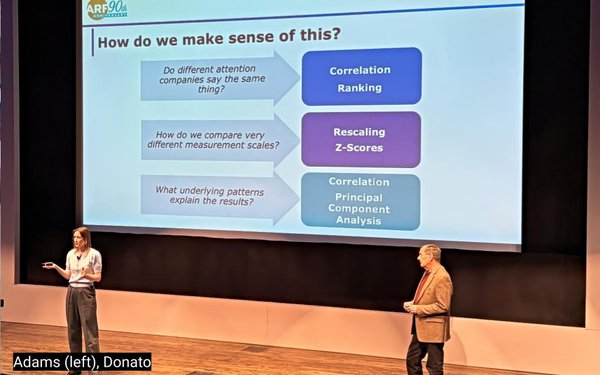
the ARF's Tracy Adams' and Paul Donato's review of Phase 3 of its attention measurement validation initiative -- is all about it.
You can read my previous commentaries on Phase 1 and Phase 2, but this year's session, dubbed "Attention As Signal, Or Beyond,"
demonstrated how many in the industry are now using attention metrics to judge relative media audience delivery, quality and ad campaign effectiveness via the many research vendors available.
However, these vendors use different approaches, definitions and techniques.
advertisement
advertisement
So, what are best practices and the most meaningful application of these resulting attention
data indicators across media that advance media planning and possibly buying well beyond commonly used “viewable impressions, sometimes referred to as “raw
impressions”?
Of strategic note to advertisers is that the Media Rating Council's and the Interactive Advertising Bureau's so-called "viewable impressions" are
solely device-based measures and therefor represent no real opportunity-to-see. Moreover, they are often self-reported by digital platforms, unaudited and with ad creative and placement rarely
independently verified.
Brand campaign case studies have proven use of attention metrics consistently delivers more cost-effective outcomes for campaigns for any given media
budget.
Phase 3 of the initiative used a complex neutral design examining media channels, platforms and placement. It involved eight research vendor attention
measurement methods and resulting metrics evaluated against campaign brand lift results across four different campaigns using three different media platforms.
From a big
picture perspective the ARF's Donato highlighted, “At the channel-level, the clearest point of agreement across research vendors was that television -- including CTV, linear TV, and
YouTube/online video -- consistently drew more attention than social media. This is likely because most measurement methods employ -- directly or indirectly -- some measure of time.”
In the platform-level analysis -- Facebook vs. TikTok -- there was consistent attention within a measurement methodology, but not necessarily across methods.
In the
placement-level analysis – feed, reels and stories -- there also was consistency within a measurement methodology but not necessarily across methods. Prime-time and late night tend to earn
the highest attention scores.
As would be anticipated, the research found attention alone does not predict brand lift, and media weight plays an important role. Amost
certainly along with many other media and campaign execution variables.
The top line implications for advertisers and their agencies are naturally broad but underline the
significant value and the complexities of paying special attention to "attention" and its pragmatic application in media planning, brand campaign by brand campaign.
Based
on the limitations of the research design, Donato and Adams offered evidence-based guidance on attention’s role in media planning, together with how to use attention metrics alongside outcomes
measures.
Understand what is actually being measured (definitions and derivations)
Use attention to evaluate media channels
Compare to company
norms.
Stick with the same measurement company over time.
Consider the interaction of attention, media weight and outcomes
As Adams emphasized, “The more important distinction may be between attention
and inattention. Advertising can work across a range of attention levels, so long as the content is not ignored.”
To which context of the medium and its editorial environment might be
added to ensure brand safety protection whatever the lift especially on social media.
While the ARF must be highly commended for the scope and depth of its three-phased
evaluation, perhaps the best prologue in the use of attention metrics comes from Havas Media Network's Jonathan Waite, which should surely be embraced by all CMOs and brand managers:
“If you are still counting raw impressions today, you aren’t a media planner. You are a passenger in a machine that doesn’t care about your brand’s health.”