Eighty-six.
If memory serves me well, that's the
precise number of times I've blurted the following phrase to my wife after watching a news report about something unbelievable 47 has done so far during this term as president: "If somebody pitched
that to a Hollywood studio it would be rejected as too ridiculous."
Yet the ridiculousness continues, including having his Injustice Department indict James Comey for allegedly threatening his
life by posting a photo of sea shells spelling out "86 47" on Instagram last year.
Of all the gaslighting Trump has done, he still seems to be reaching new heights, including changing the
meaning of common language to fit his dictatorial demands, especially his retribution against his perceived enemies.
I can't imagine the third time will be the charm for trying -- much less
convicting -- Comey for seashellgate, but I am fascinated how acting AG Todd Blanche, overacting FBI chief Kash Patel and hyperacting Trump have been twisting the meaning of "86."
advertisement
advertisement
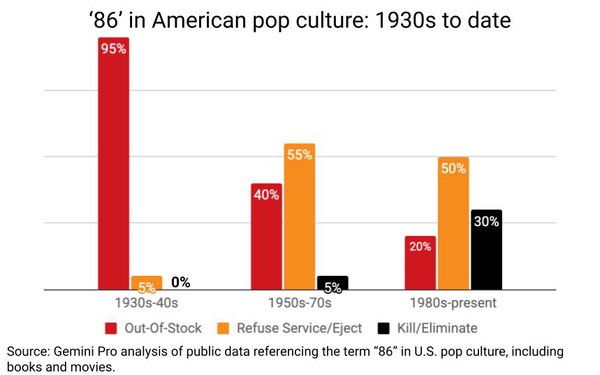
So I asked
Gemini Pro to help me conduct an analysis of public data referencing the meaning of the term "86" in American pop culture since if first began showing up in the 1930s. Keep in mind, the data it
returned -- which is depicted above -- is for illustration purposes. But you get the point.
Back in the 1930s it was mainly used by soda jerks to describe an item that was out of stock.
By the 1950s, the dominant pop culture meaning of the term was to refuse service or eject an unruly patron from the premises.
That's always been the one I've been most familiar with, but
starting in the 1970s a similar-sounding term -- "eight miles out and six feet deep" -- began showing up in books and movies about mobsters.
The two terms seem to have gotten conflated.
Either that, or we're looking at some kind of Mandela Effect.