Pollster David Shor of Blue Rose Research was back in the news recently with data showing that AI, while the fastest growing concern, is
way down on the list of things people think are important, ranking 29th out of 39. Top of the list, with nearly universal concern, is the cost of living.
Affordability trumps
AI as the biggest issue of the moment. You can prove this for yourself with an old-fashioned look at Google search trends—compared to affordability, AI barely registers.
But
you wouldn’t know this from media headlines. I asked Google’s Gemini to count the number of separate news stories on affordability and then again on AI. Unsurprisingly, Gemini said that
this was beyond its capacity. But Gemini guesstimated affordability in the “millions” and AI in the “hundreds of millions.”
advertisement
advertisement
To clarify if it wanted me to take these
contrasting descriptors literally, I asked it directly which topic had more stories. Unequivocally AI, said Gemini, noting that news about AI had experienced a “volume explosion,” with a
scale measured in the hundreds of millions.
I mention this as a reminder that the news can sometimes be a distraction. That’s especially true of affordability. Affordability is
the biggest issue facing consumers. Not AI -- not even close.
As I remind clients, AI is all about us, not about the lifestyle solutions people need and want. AI is how we as
marketers reach consumers. But it tells us little if anything about what consumers want us to do for them once we reach them. It doesn’t matter what AI tells people to buy if people can’t
afford to buy it to begin with.
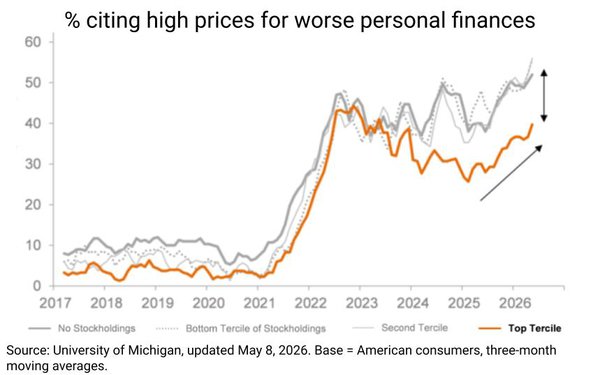
Spending in total remains strong. But look beneath the surface. Middle-class households have been trading down. Private label store brands are
enjoying a surge in demand. Higher-income households now account for about half of aggregate spending, up from the historical average of one-third or so.
Yet, wealthier consumers also say they
are feeling the pinch. Metrics that track spending patterns across all categories simultaneously show declining momentum over the past two years.
Sticker shock is everywhere.
Inflation continues to trend above the Federal Reserve target level. Mortgage payments now average over 40%-plus of monthly income, well above the 30% considered affordable.
Rents are way up
as well. Health care costs continue to escalate, both premiums and out-of-pocket expenses. Cars cost more than ever. Gas prices are high again because of the Iran war, and food prices are expected to
rise as higher fertilizer costs work their way through to the dining room table.
Pocketbooks are taking a hit. But affordability is more than making ends meet. It is a matter of
confidence in the system. Affordability is not only about prices. It is also an attitude, a reflection of how people regard the system itself and the world-at-large. Lower prices won’t fix
this.
The best evidence of this loss of confidence is the ongoing tracking of consumer sentiment in the University of Michigan’s index of consumer sentiment. Following the
pandemic lockdowns in 2020, sentiment fell off a cliff and never recovered. Sentiment recently hit the lowest level ever measured in the Michigan survey.
Looking back across the
decades of Michigan tracking, sentiment levels as low as those observed today were seen in the past only during recessions. But we are not in a recession today. Yet, consumers have a recessionary
mindset.
The historic correlation of weak sentiment
with a weak economy has been broken. Weak sentiment is now a prevailing mindset—the color of aspirations, the shape of expectations—not a temporary reaction to macroeconomic softness.
A seminal study published in 2020 on the impact of epidemics and pandemics on trust offers a big hint about
what’s going on. The researchers looked at the attitudes of people who were 18- to 25-years of age during epidemics and pandemics around the world going back to 1970. Matching this with Gallup
World Poll data, they found that coming of age during epidemics and pandemics meant lower trust decades later in government, politicians, elections and public health.
We are only a
handful of years removed from the worst pandemic in a century. The fact that trust and sentiment crashed and remain depressed should come as no surprise. That is exactly what happens, and it happened
most recently on a global scale. We are likely to see weaker sentiment for many years.
A recent essay in The New York Times attributed the collapse in fertility rates worldwide to
today’s negative “vibe” of uncertainty and disruption. It is certainly true that volatility has been the experience of life for this entire century, and dramatically different from
the so-called Great Moderation that characterized the last two decades of the 20th century. (You can see this for yourself in the World Uncertainty Index quarterly trendline.) But fertility rates have been in decline for many decades—much longer than today’s weak sentiment. The recessionary mindset we see
in society and the marketplace is a significant reset of aspirations and expectations, but it is not the explanation for everything.
It is, however, a big shift in how consumers are
engaging with brands. Consumers have become more vigilant and scrutinizing. Hypervigilance is now the characteristic style of shopping and buying. AI is being used increasingly as a tool for
fact-finding, comparisons, evaluations and recommendations. Greater scrutiny is also seen is the ways people are rethinking health, food ingredients, scientific evidence and authorities, marketing
claims, data privacy and every other sort of business or politics as usual.
Affordability is all these things, not price alone. It is price-plus. Brands can fix price but not the
"plus," if you will, which is well beyond anything brands can do. Because it is the overarching context of engagement. No point-of-sale fix will change that for the better.
What
brands can do is insulate consumers from risk. A major aspect of weak sentiment is the feeling of exposure to risk. People are spending but they no longer feel safe and secure from unexpected
financial shocks, like a car repair or a new roof or a medical expense. This is the real affordability problem. Not affording the price of groceries but security from financial adversities.
The Federal Reserve conducts a survey three times a year asking people about their spending, saving and access to credit. One of the questions asks people to estimate how likely it is that
they could come up with $2,000 if something unexpected were to happen. The six lowest estimates ever tracked have all been within the last two years, including five in row through the most recent wave
of tracking.
People feel exposed to risk. Their finances are keeping up but, increasingly, they feel at risk of ruin. The uncertainty and volatility of this post-pandemic moment have
put people more on edge, and even though they have largely—albeit not always—found workarounds for higher prices, they feel that the security of their lifestyles has, in effect, become
unaffordable.
Brands must take the risk out of buying. Which is not a panacea for people’s lifestyles, but it is the kind of reassurance that will resonate.
The iconic example is Hyundai’s Assurance program during the years immediately after the financial crisis. The job market was in a six-year decline and people were worried about their
jobs (not inflation like today, with the labor market strong). People were avoiding purchases that might stick them with obligations they couldn’t meet if they lost their jobs. Hyundai said if
you buy one of our cars but lose your job later, we’ll let you out of the contract, and thus we will not saddle you with a car payment you can’t afford. Hyundai sales took off, and
suddenly every kind of brand was offering something similar. It was all about taking the risk out of buying.
We are back to risk and risk exposure as the dominant factor in sentiment
and confidence. Indeed, it is worse than ever and likely to remain week for years to come. In this context, affordability is an attitude not merely a price. Brands must look beyond the shelf to build
a value proposition, one that will resonate with consumers who are reeling emotionally from volatility, uncertainty and disruption.