The debate over the
balance between short- and long-term marketing can get a little tiresome. But at its heart is an inescapable truth that has been given too little attention: People who may be in-market for your
product at some point in the future, may not be in-market for your product today.
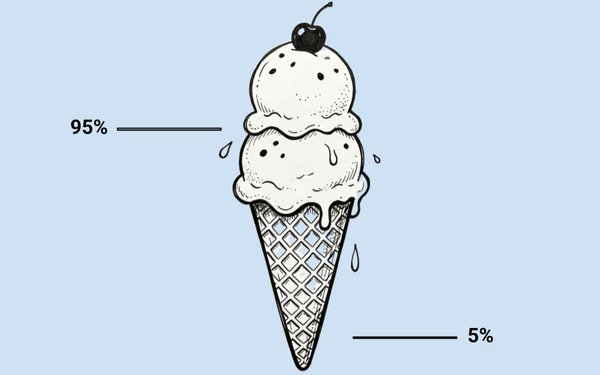
In fact, 95% of the buying universe for your product are not shopping for you now. Only 5% are.
Think about a traditional purchase funnel. Let’s start with the original AIDA (awareness-interest-desire-action) model.
The mouth of the funnel is awareness. Lots of people,
hopefully, will be aware of your business, but fewer will be interested in your product. Fewer still will desire it. And an even small number, hopefully, will act on any desire they feel and buy your
stuff.
advertisement
advertisement
An update to the funnel would recognize that awareness is a passive state. Being aware of something does not necessarily mean you are in the market for it.
So you
could start at the top of the funnel with conversation: a fairly large number of people in any category will be involved in some level of discussion about the topic, the products, or the business.
That conversation could convert to consideration: a smaller group of people will be actively interested in a few products or brands in that category.
That consideration might develop into
affinity as people develop a preference for a brand. And that affinity, with luck, will lead to action: a small group of people buying your stuff. With a little more luck, that action will result in a
degree of advocacy for your brand.
Now, clearly, all of this is a dramatic oversimplification of a complex process but for this purpose. It’s a useful simplification, which I
will illustrate with an appropriately simple example, the mattress category.
Employing the magic of the mind’s eye, picture that funnel. Starting at the top with conversation
and moving through consideration, affinity, and action, to advocacy.
The funnel is an inverted triangle. To me, it also looks like an ice cream cone. It looks more like an ice cream cone when
you put a massive scoop of ice cream on top of the cone. That scoop represents all potential buyers for your product. This is the universe of users and buyers in your category who, at some point in
time, will be actively thinking about buying what you sell.
In the mattress category, there are 134 million potential buyers in the U.S. That’s the ice cream -- the universe of
people who will, one day, buy a mattress.
On average they will be in the market every seven to 10 years. Right now, though, only about 14 million people are in any kind of conversation about
mattresses. And a little less than 54,000 of them are ready to buy a mattress.
Clearly, 54,000 is a small piece of a 134 million person pie. But here's the rub, as with all categories, the
mattress business is experiencing hyper-competition. There are 600 national brands in the mattress category now. All 600 of them are fighting tooth and nail to win their share of those 54,000
sales.
But there’s a compound problem: just two of those companies account for 45% of all mattress sales in the category. So, the other 598 are now fighting tooth-and-nail for their
share of 30,000 sales.
It’s a cage fight. And it’s no surprise that companies today are pulling out every weapon in their arsenal to try and win the fight. What other
choice do they have? But as we are seeing at a geopolitical level today, it costs a lot of money to enter a war. And in our world, war is increasingly waged at a digital level and the costs to compete
are getting ever greater.
Seventy percent or so of the average marketing budget now is allocated to a digital war over short-term sales. Put another way, 70% of the average marketing budget is
being spent to chase 5% of the potential buyers in the category. And the money that is being spent in the trenches of short-termism is money that can’t be spent on things that will create
long-term benefit.
For any business, that creates a very real issue. Marketers are doing too little to create any kind of preference or affinity among people who will be in the
market someday but are not in the market today. In effect, they have a big pile of rocks, and they are throwing those rocks at any competitor who comes over the ridge to fight them, rather than using
those rocks to build a wall that could protect them for years. Unfortunately, it becomes a self-reinforcing behavior: a truly vicious circle. But it doesn’t have to be.
Too
often we think of building the brand as an activity, the brand campaign.
But brand building is not an activity, it is a state of mind. Brand-building is not about creating great advertising
campaigns. It is about making yourself memorable and appealing to the 95% of people who are not in the market for your product today, but who will be in the future.
Brand-building is
the answer to the question: how do we do more things that more people love, things they will want to talk about, that they will celebrate, that they will recommend to others. Paradoxically, that
doesn’t cost money. It just takes commitment, clarity and creativity.
Products are going to be named. Why not give them names that are memorable, evocative and fun?
Packaging is going to be designed. Why not make it distinctive, human and interesting?
Advertising is going to be run. Why not make it talkable, shareable and notable?
The great
irony in our industry right now is that brand-building is seen as expensive and wasteful. Nothing could be further from the truth.
Done right, brand-building is cheap and effective.
Short-termism is expensive. And the ice cream is more delicious than the cone.