According to Gartner, 84% of
marketing leaders at well-funded, tool-heavy organisations still can't demonstrate what their campaigns actually drove. And not occasionally. Consistently.
The pressure behind this is
straightforward. Marketers are requested to reach new potential customers and drive incremental sales to the business. The best way to do that at scale is through data-driven collaborations with
retailers and other brands, and at the same time, leverage audience AI modeling and customer personalization. So the investment goes in, the tools go live, and the expectation is that personalization
improves customers’ experience, brands can reach high propensity customers & increase revenue.
advertisement
advertisement
For most organisations, the proof never comes, and the reason has nothing to do with
the quality of the tools.
Nobody has a full picture
Think about Spotify Wrapped. Every December millions of people screenshot it, post it on
social media and talk about it. They are not talking about Spotify’s sophisticated AI. They are talking about Spotify Wrapped being totally right about that 847 times they listened to a specific
artist.
Wrapped knows it well. And it knows because Spotify has a complete picture of every single action people do on their platform: every listen, skip, or 2 am repeat of the same song.
Every signal is captured and connected in the bigger picture.
Let’s take a closer look at Brand-Retailer relationships. Most brands in the industry experience a fundamentally different
reality. Take a consumer brand running a campaign. The brand holds its campaign logic, audience segments, years of first-party data. But the transaction belongs to the retailer. Who bought it after
seeing the campaign? Who considered it and chose a competitor instead? That population that would tell you whether the campaign actually worked is invisible to the brand.
The
retailer has transactional records, repeat purchase patterns, seasonal trends, partial CRM data. What they're missing is more specific: they can only see customers who came through their own stores.
Every customer who bought the same brand at a competing retailer is completely invisible to them. Only the brand sees all of those customers. The ad platform knows who saw the ad and who clicked. But
for most of the time, it is blindsided after the click.
Spotify knows your 2 am listening habits. Most brands can't tell who bought after their own campaign.
Connecting the data
The solution is a Data Clean Room: a secure environment where two companies can connect their datasets without either party
transferring raw data to the other. Each party retains full control of its data throughout the whole process. But for a specific, agreed analytical purpose, computation runs across both, and both
parties walk away knowing something neither could have determined independently.
The data exists – it just lives in three places that have never talked to each other.
CVS and Pinterest did this in 2024, built on LiveRamp's infrastructure and leveraging
native connection to the media platform. CVS brought data on 74 million ExtraCare loyalty members. Pinterest brought platform data across 498 million users and revealed audience overlaps between the
Pinterest user base and CVS shoppers. All ExtraCare data was pseudonymized before entering the clean room, and no personal data was transferred between parties.
The outcome was
concrete for both sides. CVS could offer its CPG partners attributed sales data connected to Pinterest campaigns for the first time. Pinterest gained anonymized first-party data that made its ad
targeting meaningfully more precise. Neither party gave anything away to get there.
After the campaign
Most organizations use clean rooms to
match data and target selected customers. It is important, no doubt. But it is only the smaller half of the opportunity. The larger one is what happens after the campaign ends.
When
campaign-exposed customers are matched with verified transaction records from a retail partner inside a clean room, the measurement loop that has always been left open finally closes. Going back to
that consumer brand, for the first time, they can answer the questions every strategic review should be built around. Which segments actually converted, how many new customers were brought to the
brand, which customers were retained or upgraded with new products. Brands can finally see what the true incremental lift was, separated from the organic and seasonal baseline. Which creative drove
the highest-value customers and attributed sales, not just paid media performance. How long after exposure conversion occurred, and what does that mean for the next campaign's timing.
The compounding effect matters. Each campaign cycle produces sharper segment intelligence. Budget conversations become grounded in verified outcomes rather than assumptions. And the
quarterly review finally has one number underneath it that everyone contributed to and can trust.
That is how the doom loop breaks.
This is where AI enters
– and in the right order
With clean room outputs in hand, AI audience modeling does something it genuinely cannot do on fragmented data.
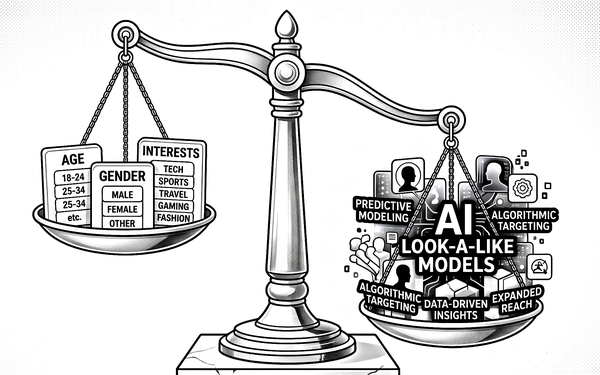
Traditional segmentation, like age, gender, and interests, has a weak connection to actual purchase decisions. The shift is toward AI look-a-like models: instead of broad demographic
buckets, AI helps expand customer segments based on real behavioral and transactional data you feed into the data clean room. Platforms like LiveRamp, Snowflake, and Decentriq enable this on top of
clean room outputs, building look-a-like audiences from verified buyers rather than assumed age and gender.
Better audience precision directly improves ROAS, lifts conversion rates,
and strengthens ROI because the brand is no longer spending against demographic assumptions but against verified purchase behavior.
The cross-platform dimension matters here too.
Clean room outputs don't just improve targeting on a single channel. They enable audience expansion across partner platforms, reaching the same high-value segments where they spend time, whether
that's a retail media network or a streaming platform. Matching on passion points, like sport, fashion, wellness, entertainment, allows brands to find and engage their best audiences far beyond the
channels where the original campaign ran.
Final thoughts
Moving this forward is a strategic decision. Three things need to be in place
before the next campaign launches.
A clean room partnership with at least one retailer or other brand rather than your own, with post-campaign analysis as the primary use case.
The output is verified conversion data matched across brand and partner, and it is what makes every downstream decision more defensible, from budget allocation to audience strategy.
Audience segments rebuilt around actual purchase behavior, category patterns, interests, and purchase cycle data rather than demographic proxies. The precision of those segments
determines the match rate in the clean room, the quality of the AI modeling that follows, and ultimately the ROAS, CVR, and ROI the campaign delivers.
A shared measurement framework
agreed across brand, retail, and agency partners before the campaign launches. One set of KPIs, so that when the campaign ends, there is one answer in the room.
The brands
breaking out of the doom loop aren't doing it by investing in better tools. They're doing it by connecting the data that already exists across their partner ecosystem and building their audience
strategy, their channel decisions, and their AI modeling around it.