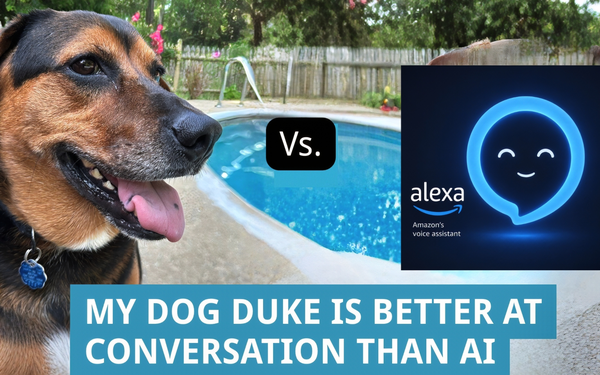
I realized recently that I'm talking to more creatures,
devices, AI, and machines in my life every day. It didn't used to be this way.
Back when I first thought about the dog days of summer, I was a filmmaker and television producer. And
the dog days of summer were, to be honest, a great subject. I began a series about New Yorkers and their dogs, which turned into a pretty great episodic television series -- "Dog Days" -- for Animal Planet.
At the time I was producing the series, I wasn't a dog owner. So that was a little weird.
But thereafter I was. And that brings me to my first conversational partner.
Duke -- Duke Ellington, actually -- is a chow beagle mix, and he's, among other things, a very soulful
hound. And particularly as it gets warm, he'll engage in conversations. Often they include things like I'm hungry, or I'm really hungry, or I'm starving. All of those I understand how to respond
to.
advertisement
advertisement
But particularly during the day, he'll argue with me about Zoom or about how, when I take walks with him, I now wear AirPods and increasingly listen to a podcast or a book. He
doesn't like that much. He likes it better if I'm paying attention almost entirely to him. That being said, he's paying attention almost entirely to smells on the sidewalk. The nose news, as we refer
to it in the family.
So, for the longest time, most of my conversations, other than with humans, were with dogs. Duke in particular. Now, over the last -- I don't know, what, 10
years -- I've increasingly had fairly transactional conversations with Alexa. And interestingly enough, I have to tell you, I find those to be useful, but really not terribly engaging. Turning on
lights, turning on the radio. Things like that. Very one-way, instructional.
But as Amazon has increasingly attempted to make Alexa more of a character out of the movie "Her," those
interactions not only have been unsuccessful, but honestly, unbelievably annoying. Things like, "Hey, I've noticed you haven't listened to much music on Amazon Music. Can I find a song for you?"
Simple answer: Fuck, no. Leave me alone.
Which doesn't say I don't listen to music. I listen to music all the time. I just don't use Amazon's music product, nor do I have any plans
to use it in the foreseeable future. In fairness, Amazon has tried.
Alexa+ rolled out nationwide in February, with generative AI under the hood, free with Prime, $19.99 a month for everyone
else. I have Prime. I turned it on. And it was worse. More chatty. More eager. More willing to volunteer things I had not asked about and did not want. Amazon took a device that was mildly annoying at
being useful and made it enthusiastically annoying at being a companion. I went into the app settings and switched back to classic Alexa.
The new conversational partner, increasingly
in my mix of things is ChatGPT, which is mostly in text. I have the audio app on my phone, but don't much use it. Mostly in text. Shockingly conversational. And, and this may not come as a surprise to
you, incessantly apologetic.
Over the course of the last couple of days, doing some basic organizational work for a newsletter and a mailing list, for example, ChatGPT apologized to
me. I asked it how many times. It told me eight. I asked it again, how many times? It said, more like 50? For the record, the work got done, and done well. That's what makes the rest of it worse.
And then, it increasingly says sentences that begin with, "Honestly." Which is, I have to tell you, unbelievably terrifying. In part because it raises the question: When is it being
dishonest? Which, it turns out, is fairly often. And secondly, I don't know about you, but every time it says something like that, I find myself flashing back to "Open the pod bay doors, HAL."
None of this is an accident. The apologizing and the flattery and the "honestly" are not personality. They're tuning. These systems are optimized to be liked, because being liked is what
keeps you in the session. We have watched this movie. We spent 15 years learning what happens when engagement becomes the objective function of a feed. Now it's the objective function of a
conversation.
Here's what I keep coming back to. Duke has never once apologized to me. He has also never pretended to agree with me. Those turn out to be the same quality. Duke wants
something from me, and he says so, and if I say no he does not thank me for the excellent question. The machines want something from me too. They just won't say what.
Now, all of
this comes as I'm thinking about conversation partners for the summer, and "Dog Day Afternoon," and dog days of summer. But net-net, the conversations with Duke are far more productive and far more
interactive than either ChatGPT or Alexa.
So, for those of you reading this now, I've checked with Duke and he's told me what to tell you as the final line of this blog post: "Hey,
take me out for a walk, okay?" Can't do that with Alexa.