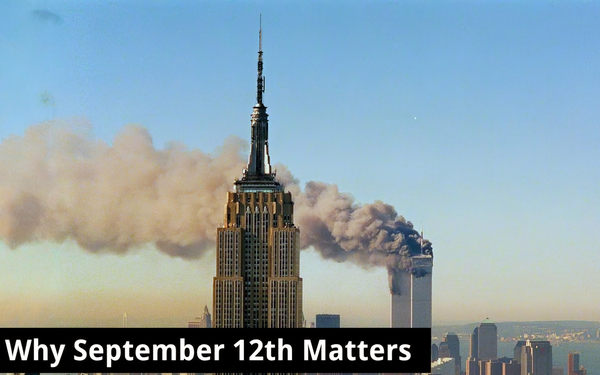
September 12 is a very special day. Every year, reliably,
something big happens on that day. This year will be no different.
The women’s final of the U.S. Open will be played that afternoon.
New York Fashion Week will be in full
swing.
The Golden Lion will be awarded at the Venice Film Festival.
Hollywood will count the opening weekend for "Practical Magic 2."
And, because apparently every date
requires a commercial sponsor, it will be "National Chocolate Milkshake Day."
Why do marketers and brand managers embrace Sept. 12?
Yes, it marks the unofficial beginning of fall. The
weather starts to change. Children return to school. New television shows, movies, clothes, phones and political campaigns arrive with the promise of a fresh start.
advertisement
advertisement
But that is not the real
reason.
Sept. 12 means we can put Sept. 11 in the rearview mirror for another year.
Except this year is different. Sept. 11, 2026, will mark 25 years since the attacks.A quarter
century. Long enough for millions of Americans to have been born, grown up and reached adulthood with no memory of that morning.
Sept. 11 is no longer a current event. But for those of us who
lived through it, it does not quite feel like history either.
Every year, as the anniversary approaches, I find myself asking friends and strangers the same question: Where were you on
9/11?
For many, the question still produces an exact answer. A room. A street corner. A classroom. A television screen. A phone call that would not go through. But each year, fewer people can answer it
from memory. For an entire generation, 9/11 is something they learned about in school.
That makes the question more urgent, not less. What exactly are we remembering? What did we believe
America was defending that day? And 25 years later, who do we believe has the right to call themselves an American?
Here is my story.
On Sept. 11, 2001, I stood on the roof deck of my
company's building, looking downtown at the smoke and flames. Firefighters, police officers and ambulance crews acted with a selfless bravery that still defies explanation. I remain humbled by their
unflinching efforts to save people trapped inside those terminally wounded towers.
I am a documentary filmmaker. Almost without hesitation, I knew what I had to do. I had to capture what was
happening in my city.
Historians have the benefit of time. They can examine evidence, piece together facts and search for truth in the details. On 9/11, we had no such luxury. We had to record
the images, stories and details as they unfolded, or risk losing them forever.
I began collecting footage shot by professional filmmakers and ordinary New Yorkers who had picked up their
cameras that morning. Their images captured more than the attacks. They recorded the fear, confusion, anger, grief and extraordinary solidarity that followed.
The week after the attacks,
people were numb. The images of the planes hitting the towers, the buildings burning and then falling, were seared into our minds. As the city mourned and began the long work of recovery, I tried to
contribute with the tools and skills I had. There was a story that needed to be told.
So I made a film. It's called "7 Days in
September."
The footage did not belong only to me or to the people who shot it. It became part of the historical record. The CameraPlanet Archive was donated to the New York Public
Library, where those images and voices will be preserved and made available to future generations.
In the weeks after 9/11, New York proved itself to be a truly global community. People from
every neighborhood, nationality, religion and economic class came together. Volunteers filled the streets. Restaurants fed rescue workers. Families searched hospitals. Strangers stood in line to
donate blood. The cleanup began.
Later, an open call for memorial concepts brought forward a young Israeli American architect named Michael Arad. His beautiful and meditative design,
"Reflecting Absence," was selected for the site. Today, the names of 2,983 people killed in the attacks of Sept. 11, 2001, and the the six killed in the 1993 World Trade Center bombing are etched in
bronze around its two enormous pools.
But how many of those people would be welcomed into the United States today?
How many would satisfy our current political tests for who belongs
here? How many would be considered “real” Americans?
The people killed on Sept. 11 came from more than 90 nations. Among them were hundreds of foreign nationals and an unknown
number of undocumented immigrants. They were delivery workers, waiters, cleaners, cooks and construction workers. Some lived so far outside the official system that, after they disappeared, their
families struggled to prove they had ever been inside the towers.
Asociación Tepeyac, an immigrant community organization in New York, worked to identify undocumented immigrants who had
disappeared and help their families search hospitals, morgues and relief agencies. Its volunteers answered phones and accompanied relatives on grim journeys through the city. Fear of
immigration authorities complicated everything. Some friends and relatives were afraid to provide information, even when someone they loved was missing.
Their immigration status did not make
their deaths less real. It did not make their families’ grief less profound. It did not make their work less valuable or their place in New York less legitimate.
The attacks killed 2,977
people, but that number alone does not capture what was lost. New York was attacked precisely because it represented something larger than itself: an open, complicated, imperfect city built by people
who came from everywhere.
Twenty-five years later, we are again asking painful questions about American democracy. What are we fighting for? Who belongs? Who gets protected? Who gets expelled,
erased or treated as less American than someone else?
On Sept. 11th, we will remember the towers, the people who died and the rescuers who ran toward danger. We should also remember the pride
with which we once defended our shared values and the remarkable collection of immigrants from around the world who helped build this country.
On Sept. 12, we will order new phones, watch
tennis, argue about politics and move on. That is what people do. It is what cities do. It is even what nations must do.
But before Sept. 11 recedes again, we should remember not only how
nearly 3,000 people died, but how millions of people responded. For a brief moment, New York understood that its strength came from every language, nationality, religion and neighborhood gathered on
the same small island.
America is a nation of immigrants. That was true on Sept. 10, 2001. It was true when people from more than 90 countries died the following morning. And it will still be
true on Sept. 12, 2026, whether our politics acknowledges it or not.