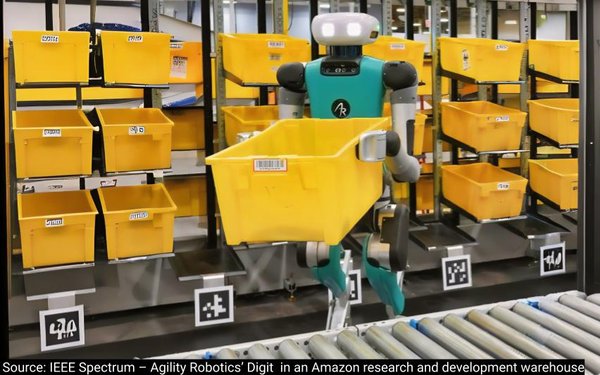
Most robotics companies seem to be focused on
building humanoids. And if they’re not humanoid, they tend to resemble other things familiar to us like dogs or cars.
There does not appear to be a lot of innovation around truly new
structures or approaches. Why? Because our world is inhabited and built by humans. Door handles, kitchens, factories, cars, and warehouse shelves were all designed around our anatomy. So, when
engineers build a robot, they default to recreating an artificial “being” to fit the environment we already have.
We do the exact same thing in marketing with AI. Instead
of rethinking how a brand connects with a human being, we build AI agents to do the jobs listed on our current Statements of Work. We make an agent to write a brief, an agent to slice 50 banner ad
variations, an agent to optimize bids, and an agent to compile reporting decks.
advertisement
advertisement
We are applying brilliant computing power to automate the "horseless carriage." But true innovation
isn't doing legacy work faster. It is asking why we are doing the work in the first place. I believe there are two structural roadblocks keeping us stuck in this loop.
- Operational Inertia: It is infinitely easier for an agency to pitch a Chief Marketing Officer by saying: "Our proprietary platform generates 500 display banners in four
minutes.” It requires zero organizational redesign. The department keeps its shape, approval chains stay intact, and procurement celebrates cutting a few hours off a retainer. Re-architecting a
marketing process meaningfully means changing how decisions get made, who holds budget authority, and, most importantly, how teams are structured. Most companies simply don't have the stomach for that
level of disruption.
- Misaligned Financial Incentives: Legacy agency commercial models actively discourage radical innovation. When agencies bill on hourly
retainers or a percentage of media spend, they are incentivized to maximize manual activity and spend.
If an agency uses AI to eliminate a legacy step, they stand to lose
revenue. So, what happens? They slap a generative AI wrapper on the old workflow, call it an "end-to-end platform," and charge a new platform fee. It's a revenue-preservation strategy disguised as
progress.
And advertisers are at fault here, too. If you want true innovation, you will need to lean in hard and that takes time, effort and inspiration. Sadly, most marketing
departments are both designed for, and incentivized on, outputs and efficiency. AI can help with that, but as indicated, that requires little imagination and innovation.
So how do we
break the cycle? For starters, you have to stop asking “How do we automate this task?" and instead ask “How can we make this task deliver incremental growth?”
Re-architect the Agency Scope. Stop incentivizing agencies for incrementalized assembly lines. Yes, algorithms can handle operational tasks like bid pacing, keyword match sculpting, and
variation testing better than humans and a lot more. But pay human talent for original thinking and strategic evolution.
Move away from percentage-of-spend models or hourly
retainers. Shift to a lean base retainer for governance, combined with project fees for strategy and outcome-based incentives tied to verified growth or profit.
And perhaps most
importantly, shift your focus from campaign volume metrics (clicks, impressions, platform ROAS) to commercial outcomes (for instance net profit contribution or lifetime value). We don't need smarter
software doing dumb work faster. It is time to burn down the legacy process and build an operating model fit for the present.