Oops, I mean "The Gauge," but you get my drift.
Footnotes aside, Nielsen has spent months willfully publishing bogus, lame duck data spinning streaming's dominance over linear TV during the upfront even though it knows it is wrong and plans to
recalibrate it effective with the new TV season.
What could Nielsen's reason possibly be?
To answer that question, I went back to Nielsen's June 2021 press release announcing "The
Gauge" and explaining what it was: "a monthly visualization of how audiences in the U.S. are using streaming services on their TVs, as well as how that usage stacks up to traditional broadcast and
cable television. Not only will it provide a high level look at the evolving TV landscape overall, it’ll also reveal how specific streaming services are performing compared to one another."
The problem is that the methodology Nielsen used to generate the monthly reports was inaccurate for several reasons, especially the universe estimates Nielsen used to calibrate streaming vs. linear
TV viewing sources in U.S. TV households.
advertisement
advertisement
And even though Nielsen was aware of those problems, it continued to publish "The Gauge" reports showing streaming's rapid ascendancy -- indeed its
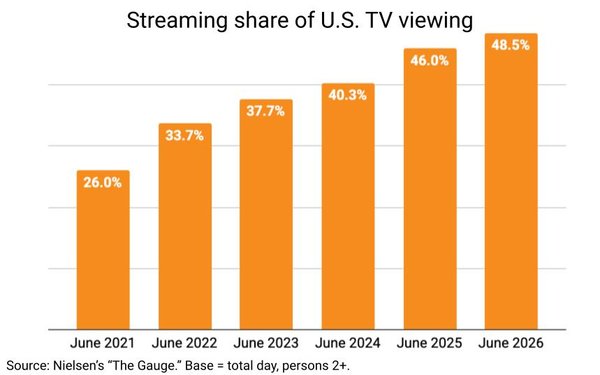
actually leap-frogging over linear TV viewing in May 2025 when it published that year's "June" edition of "The Gauge" -- until the Media Rating Council finally blew the whistle that Nielsen was dragging its feet
on fixing "The Gauge's" methodology.
Following some fits and false-starts, including an aborted plan to begin publishing recalibrated "Gauge" data showing that streaming was
not actually the dominant TV viewing source -- at least not yet -- Nielsen backtracked and said it would continue publishing "The Gauge" using what it knew to be a bogus methodology until the
September.
Hmmm, I wonder what annual media-buying marketplace that lag period coincided with?
We may never know what impact Nielsen's decision to willfully continue publishing
unrepresentative TV viewing share data during an upfront negotiating season actually was, but we do know it bought streaming services time to continue spinning their ascendancy while billions of ad
dollars were being negotiated.
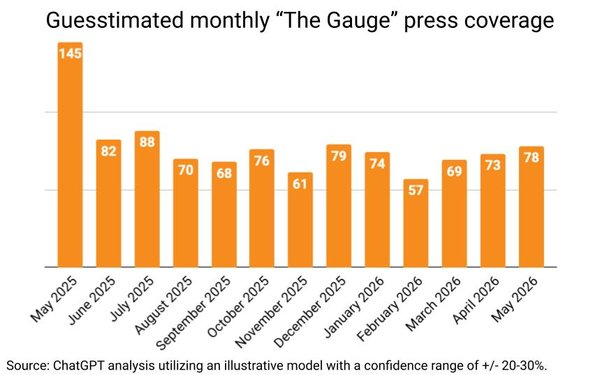
It also generated hundreds of articles published by leading trade publications, wire services, newspapers and blogs reporting on the March through June monthly
edition of "The Gauge's" findings, though some at least cited the footnote in the bullseye of "The Gauge's" visualization disclaiming that the data does not actually reflect Nielsen's "currency" TV
ratings and that it's methodology would be rebooted to do so with the start of the Fall TV season. You know, after the upfront.
So why did Nielsen make the decision to continue publishing
knowingly inaccurate "Gauge" share estimates?
For the only plausible answer I can come up see the graphic below.