-
by Bill Daddi
, Op-Ed Contributor,
October 2, 2026
CIMM's and the 4As' "Paradox of Plenty" study, released earlier
this year, found that as measurement capability has increased significantly, confidence in it has actually lagged.
The report characterized it as a "crisis of confidence," with advertisers
struggling to reconcile different sources, definitions and metrics of providers.
This is not a new occurrence. Back in 2017, Advertiser Perceptions' "State of Advertising Measurement"
study found only 33% of end-users considered their audience insights "completely trustworthy."
Certainly, as an industry, we could do a better job of engendering trust.
Industry bodies
-- such as the Media Rating Council through its accreditation efforts, and the Interactive Advertising Bureau through its guidelines and frameworks -- are leading efforts to advance this, but a
framework outlining what the common elements of trust should be would give us all a roadmap to follow.
advertisement
advertisement
While such a framework would need to be developed with the participation and consensus of
a broad cross-section of the industry, what might the elements of it be?
Consider that in this context, "trust" is not so much about skepticism over data accuracy as it is about understanding
how that data was derived and how to utilize and make sense of it all.
As CIMM put it in its report, "Marketers, more than ever, have access to a world of plenty, but paradoxically feel
increasingly challenged to derive clear conclusions on the impact of their advertising investments. Confidence is strongest where signals are direct and operationally familiar, and more measured where
insights depend on stitching together datasets, modeling outcomes, or reconciling multiple systems."
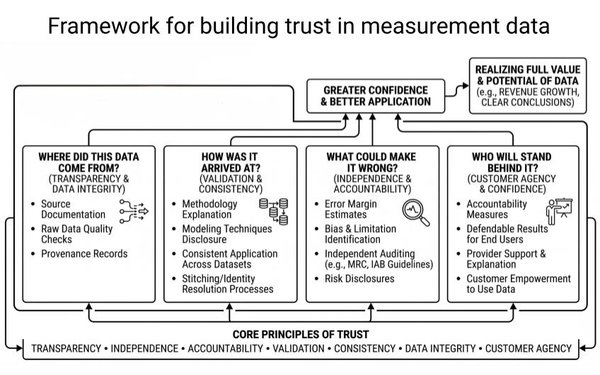
To that end then, a usable framework of trust should be focused on answering four basic
questions for the end user:
- Where did this data or insight come from?
- What could make it wrong?
- Who will stand behind it, meaning can you defend and explain the result if challenged?
These are basic questions that all providers should be able to answer, but they are based on
what are really the main principles of trust: transparency, independence, accountability, validation, consistency, data integrity and customer agency.
Ultimately, trust is not just about
fulfilling one's ethical responsibilities, it is about realizing the full potential and value of data as well. Trust and understanding about how data was derived leads to greater confidence in its use
and better application of it.
In fact, a study by Anteriad found marketers who trust their data are three times more likely to report revenue growth.
A common framework outlining what
the elements of trust are would give all providers consistent principles to align with and end-users assurance that their voice is being heard.
With ever increasing complexity in measurement,
the need for trust in data as a way of facilitating understanding and confidence will only grow.
A unified approach to accomplishing this can play an important part in helping to ensure that
need will be met.