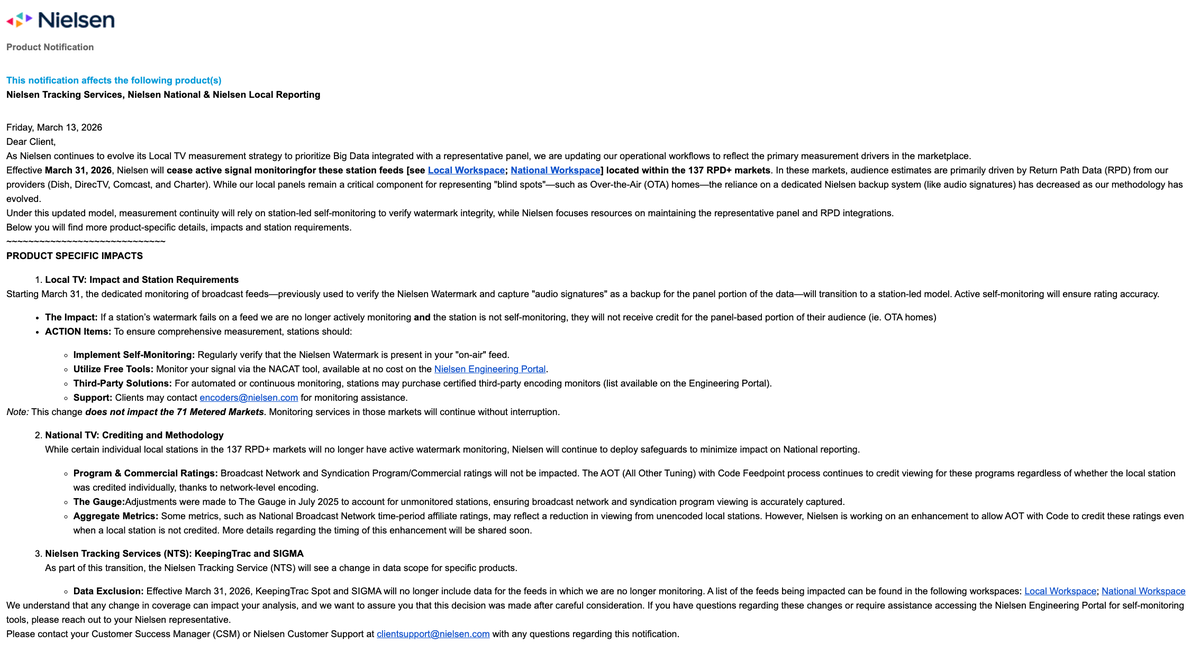
Nielsen late last week began informing clients that, effective March 31, it will discontinue
monitoring ads on TV in 137 markets. The news comes on the heels of Nielsen’s decision to also discontinue its radio advertising monitoring service – SIGMA Radio –
ad the end of the month, something some sources see as cost-cutting moves as Nielsen focuses on the bigger, more complex issues associated with the overhaul of its national Big Data + panel audience
measurement service, which more of less still is the national currency for TV advertisers heading into this year’s upfront advertising marketplace.
The 137 markets Nielsen is
ceasing to monitor ads in are so-called “RPD+” markets relying on return path data from cable and satellite TV providers(Dish, DirecTV, Comcast and Charter) for measuring viewers in what
generally are smaller TV markets. The 137 markets previously used paper diaries to measure demographics and audience composition, but Nielsen made the conversion to “electronic
measurement” in the fall of
2019.
advertisement
advertisement
“As Nielsen continues to evolve its local TV measurement strategy to prioritize Big Data integrated with a representative panel, we are updating our operational
workflows to reflect the primary measurement drivers in the marketplace,” Nielsen said in the notice sent to
clients late Friday,, adding, “While our local panels remain a critical component for representing "blind spots"—such as over-the-air (OTA) homes – the reliance on a dedicated
Nielsen backup system (like audio signatures) has decreased as our methodology has evolved.”
The use of the term blind spots is noteworthy, because Nielsen recently began
recalibration the universe estimates it uses as the basis of its TV measurement systems based on highly-regarded third-party research, the Advertising Research Foundation’s DASH service.
According to recent estimates published by DASH, OTA – households still using an antenna to receive their TV via a broadcast signal – represents more than 15% of the total TV
universe, and more than 20% of the linear TV universe, excluding digital-only TV access.
“Adjustments were made to The Gauge in July 2025 to account for unmonitored stations,
ensuring broadcast network and syndication program viewing is accurately captured,” Nielsen noted in the client notice, but it didn’t detail exactly what those adjustments were, or how
they were derived.
Nielsen began recalibrating its estimates based on DASH data at the end of January 2026 and its updated estimates will be published in the March edition of The
Gauge on March 24 – a week later than normal – representing a readjustment of its February total day TV usage data.
Ad for advertisers, agencies and stations that
previously relied on Nielsen’s active commercial monitoring in the 137 TV markets, Nielsen said they will have to rely on stations actively “self-monitoring” their watermarks.
“The impact: If a station’s watermark fails on a feed we are no longer actively monitor and the station is not self-monitoring, they will not receive credit for the
panel-based position of their audience (ie. OTA homes,” Nielsen explained.
The primary customers for Nielsen’s TV commercial tracking service are commercial, direct
response and public service announcement (PSA) advertisers and their agencies.
The notice goes on to recommend stations “regularly verify” the presence of Nielsen’s
watermarks in their on-air feeds or purchase “third-party encoding monitors” to do so.