Somehow, with everything that is
happening down here on planet Earth that is raising people's blood pressure and triggering anxiety attacks, civilization still managed to send four people on a round-trip voyage to the dark side of
the moon and back.
The fact that this civilization was the one we enjoy here in the United States of America was icing on the cake.
Americans went to the moon, and many watched the coverage on TV and were in awe. For those old enough to remember the Golden Age of the space program in the 1960s and early ’70s, it
seemed like old times.
The countdown, the lift-off, the rocket heading up, up and away out of Earth’s atmosphere, the “slingshot” around the moon, the
voyage home and the splashdown -- all successful.
advertisement
advertisement
Then came the smiles, waves and thumbs up from the fab foursome of Artemis II as they touched down in their rescue
helicopters on the deck of the USS John P. Murtha of the U.S. Navy.
With the conclusion of the 10-day mission to the farthest reaches of space ever visited
by humans, Americans of every stripe had every right to be proud of their country -- something that is all too rare these days.
For reasons that I cannot
quite put into words, the fact that it was NASA that choreographed this singular achievement in world history felt more appropriate than if the mission had been staged and paid for by a private-sector
space company such as Space X.
It should go without saying, but as a government agency, NASA represents all of us. Elon Musk does not. Thus, the achievement
was one we could all share.
By flying where no man or woman had ever flown before, Artemis II was in a unique position to capture views of Earth that were
not possible before.
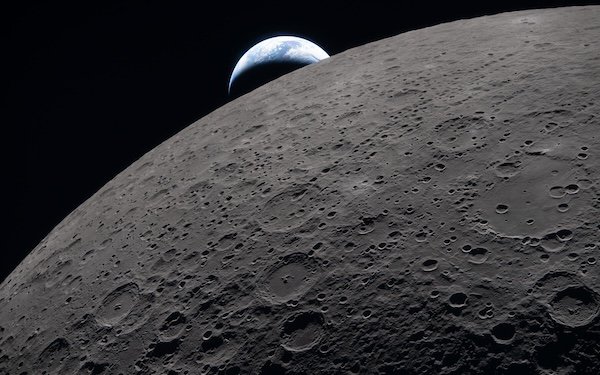
The photo above was taken just before the Orion orbiting spacecraft flew out of range of contact with Earth.
Instead of attempting to further explain the photo on my own, I am letting NASA do it in the description below,
taken verbatim from the NASA website.
The lunar surface fills the frame in sharp detail, as seen during NASA’s Artemis II lunar flyby, while a
distant Earth sets in the background. This image was captured at 6:41 p.m. EDT, on April 6, 2026, just three minutes before the Orion spacecraft and its crew went behind the Moon and lost contact with
Earth for 40 minutes before emerging on the other side. In this image, the dark portion of Earth is experiencing nighttime, while on its day side, swirling clouds are visible over the Australia and
Oceania region. In the foreground, Ohm crater shows terraced edges and relatively flat floor marked by central peaks -- formed when the surface rebounded upward during the impact that created the
crater. Photo credit: NASA