advertisement
advertisement
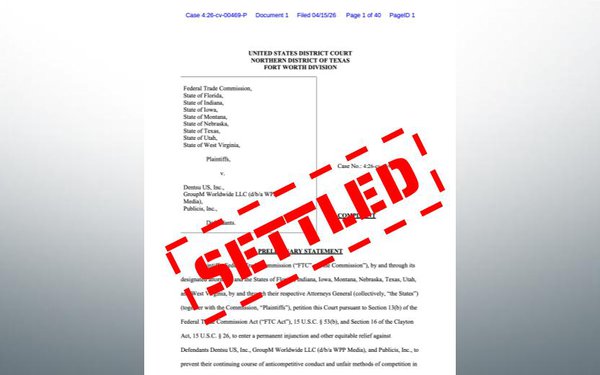
The Federal Trade
Commission this morning announced agreements with three big agency holding companies -- Dentsu, Publicis and WPP -- to discontinue what the FTC described as "unlawful collusion that imposed uniform
standards on brand safety.
Citing previous agreements by Interpublic and Omnicom as part of the FTC's regulatory approval of their merger late last year, the federal agency said Dentsu,
Publicis and WPP have also agreed to a proposed order that "will stop the alleged coordinated conduct and prevent similar conduct from occurring in the future."
“WPP Media confirms that
it has reached agreement on a mutually acceptable consent order with the FTC on a no admit nor deny basis," WPP Media said in a statement, adding, " We are pleased to finalize this agreement with
the FTC which reflects our existing and ongoing commitment to provide our clients with unbiased advice as they decide where to place their media.”
"Dentsu remains fully committed to
operating transparently, with integrity, and in strict compliance with all applicable laws," the company said in a statement provided by a spokesperson. "Our dedication to delivering value and
maintaining the highest standards of compliance is unchanged."
“The ad agencies’ brand-safety conspiracy turned competition in the market for ad-buying services on its
head,” FTC Chairman Andrew Ferguson said in a statement, adding, “The antitrust laws guarantee participation in a market free from conduct, such as economic boycotts, that distort the
fundamental competitive pressures that promote lower prices, higher quality products and increased innovation."
“As we explain in our complaint, the brand-safety agreement limited competition in the market for ad-buying services and deprived
advertisers of the benefits of differentiated brand-safety standards that could be tailored to their unique advertising inventory,” he continued. “This unlawful collusion not only damaged
our marketplace, but also distorted the marketplace of ideas by discriminating against speech and ideas that fell below the unlawfully agreed-upon floor. The proposed order remedies the dangers
inherent to collusive practices and restores competition to the digital news ecosystem.”
The FTC cites all of the named holdco's utilization of data from "firms like NewsGuard and Global
Disinformation Index" to "promote the demonetization of disfavored political viewpoints. In a competitive market, ad agencies compete for advertisers’ business by offering brand-safety tools
that provide the best quality at the lowest cost. The brand safety agreement displaced competition by insulating the ad agencies from these competitive conditions, according to the complaint."
"This is supposed to be a collusion case, but we don’t work with the ad agencies signing the consent order and our ratings are based on non-partisan journalistic standards, not political
orientation," NewsGuard Co-CEO Gordon Crovitz said in a statement, adding, "The fact that the FTC announcement nonetheless targets NewsGuard is further evidence that Andrew Ferguson is simply
responding to the lobbying of Newsmax, which is upset that it gets a significantly lower rating from NewsGuard than its prime competitor, Fox News.
"We don’t
believe the FTC should be the arbiter of political bias or seek to censor our work, which is why we have sued the FTC for jawboning Omnicom into agreeing to a similar consent order as a condition of
its merger with IPG."
The FTC complaint also alleged the holdcos "operated through their trade associations -- specifically, the World Federation of Advertisers’ Global
Alliance for Responsible Media (“GARM”) and the American Association of Advertising Agencies’ Advertiser Protection Bureau (“APB”) -- to establish their common
brand-safety standards. Under the agencies’ brand-safety agreement, websites that included so-called “misinformation” were deemed to fall below the brand safety floor and thus risked
becoming categorically ineligible for advertising revenue."
The settlement still needs to be approved by a federal judge.