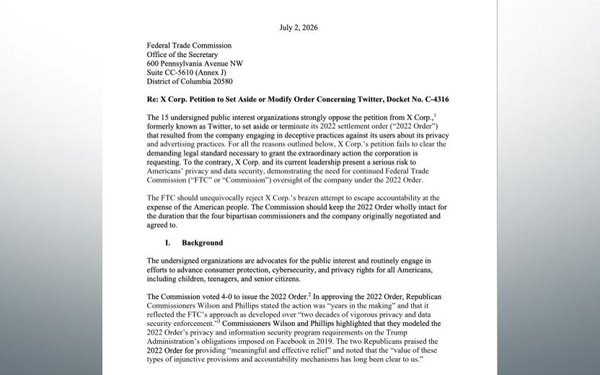
Elon Musk's bid to vacate a consent decree between X and
the Federal Trade Commission has drawn opposition from consumer privacy watchdogs, but 13 state attorneys general back his petition.
The consent decree, entered into in 2022,
settled allegations that the platform -- formerly Twitter -- misled users by asking for their phone numbers and email addresses for security purposes, but then using the data for ad targeting.
X, which was acquired by Musk several months after the consent decree was issued, argued in a petition filed in May that the company significantly changed in the last
four years.
advertisement
advertisement
"Every individual responsible for the underlying failures has left, and X has since built a world-class privacy and data-protection program that its own personnel
regard as a crucial element of the company’s culture," the company wrote.
The platform added that complying has cost "close to $17 million" in paperwork, and diverted resources from developing artificial intelligence technology.'
Fifteen advocacy groups -- including the Electronic Privacy Information Center, Consumer Federation of America, Electronic Frontier Foundation and Public Citizen -- submitted comments urging the FTC to "unequivocally reject X Corp.’s brazen attempt
to escape accountability at the expense of the American people."
The organizations claim the company still poses a threat to privacy, citing a Forbesreport that 2.8 billion records were leaked by X last year.
They add that X Corp's AI initiative "should prompt greater FTC oversight of the company’s privacy practices, not less," arguing that the largest companies developing AI are
collecting "immense amounts of consumer data."
"Given this insatiable need for personal data, X Corp. faces a greater incentive to collect and use data from its social media
platform for AI development," the groups write.
Others, including a 13-state coalition led by Iowa, say the consent decree should be terminated.
Among
other arguments, those states contend the Biden-era FTC "weaponized" the consent order "to interrogate core First Amendment activities."
"The record reveals that under
President Biden, the FTC abused the Order’s demand-letter authority to launch investigations completely untethered from consumer privacy," the state attorneys general write.
They support that claim by referencing a December 2022 letter from the FTC to Twitter in which the agency sought information regarding material shared with journalists who reported on
the so-called “Twitter Files” -- which involved the company's prior editorial decisions --
including the brief suppression of a New York Post story
about Hunter Biden's laptop.
Despite the states' characterization of the investigation as "untethered" from privacy, former FTC Chair Lina Khan later told lawmakers the agency was specifically investigating a privacy issue -- whether Twitter disclosed
users' private communications to the journalists -- in violation of the earlier consent decree.
She added that the FTC's probe revealed that Musk told employees to take action
that would have violated the consent decree, but “longtime information security employees” at the company intervened and instituted privacy safeguards.
The
attorneys general add that the consent decree is an "outdated bureaucratic encumbrance" that will hinder efforts to "advance American leadership in artificial intelligence."
The settlement between the FTC and Twitter stemmed from the company's 2019 disclosure that it
inadvertently allowed marketers to target users based on phone numbers and emails collected for security purposes.
The company said at the time that the emails and phone
numbers were mistakenly incorporated into an ad platform that allows companies to use their own marketing lists -- which include customers' email addresses and phone numbers -- to target ads on
Twitter.
X resolved the matter in May 2022 by agreeing to pay $150 million and to follow a number of conditions. Among others, the company promised to create a privacy and
security program, obtain biennial evaluations of that program by an independent assessor, conduct risk assessments before implementing or modifying new products, and respond to the FTC's requests for
information.
When X settled the matter, it did not admit or deny the FTC's allegations.