Bringing their heavyweight battle in GLP-1
brand marketing into the federal courts, category founder Novo Nordisk on Tuesday sued category leader Eli Lilly to stop what it calls “multiple misleading national ad campaigns.”
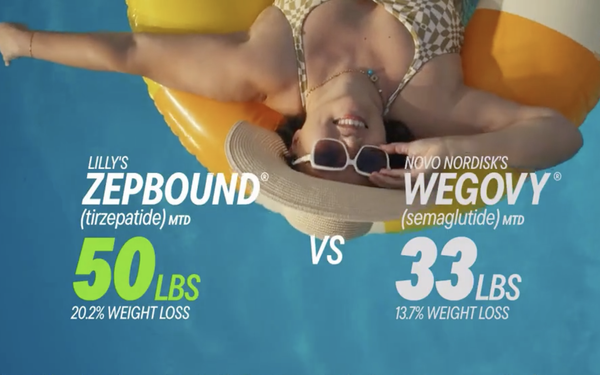
In one such campaign, which began early this year, Lilly cites a study showing that users of its Zepbound weight loss med lost an
average 50 pounds versus just 33 pounds for users of Novo Nordisk’s Wegovy.
Novo said the campaign -- which “has aired during recent, widely viewed global sporting broadcasts and
on TikTok and Facebook” -- has caused “widespread confusion” because it does not compare Zepbound to a higher dose of Wegovy approved by the FDA in March, which has shown an average
47 pounds of weight lost.
advertisement
advertisement
A similar recent head-to-head comparison campaign between Lilly’s type 2 diabetes med Mounjaro and
Novo competitor Ozempic shows average weight losses of 25 pounds vs. 13 pounds respectively. Ozempic numbers are shown for a 1 mg dose, but Novo complains that the FDA “approved a higher,
more effective maintenance dose of Ozempic® (2 mg) more than four years ago.”
In short, the Novo Nordisk lawsuit alleges that Lilly has been using
“intentionally selected outdated studies that compare Lilly’s highest doses against lower doses of Novo Nordisk's medicines, deceptively presenting those results as proof of broad,
product-level superiority while burying or omitting critical clinical context.”
Lilly contends that its ads are citing the only head-to-head studies that have been conducted.
In
a statement given to CBS News, Lilly said its advertising "is truthful, transparent, and grounded in the most direct scientific evidence available — exactly what patients deserve... We will
continue to focus on the science and defend against this lawsuit vigorously."
“Healthcare companies have a responsibility to keep their public claims accurate and
current,” countered John F. Kuckelman, Novo’s senior vice president and group general counsel, in a statement. “Ineffective, fine-print disclaimers do not fix the misleading
impression created by major national campaigns.”
Before filing its lawsuit, Novo said, it had sent a “formal cease-and-desist request” asking Lilly “to pull down or
meaningfully correct certain ads,” but was refused.
Based in Denmark with U.S. headquarters in Plainsboro, New Jersey, Novo filed the lawsuit in the U.S. District Court for New
Jersey.
The suit not only seeks a permanent injunction requiring Lilly to pull “its misleading comparative advertising across all platforms” but also “to conduct a corrective
advertising campaign,” Novo said.
Furthermore, if Lilly does not pull its ads voluntarily “in the coming days,” Novo said it will seek “a preliminary injunction to
immediately block them.”
Novo Nordisk’s lawsuit comes as its once dominating position in the GLP-1 market that it launched has eroded, with CNBC reporting earlier this year that
Novo’s market share had dwindled to about 40%, with Lilly at 60% market share.
The decline is “not simply the result of superior science,” Richard Meyer wrote in The World
of DTC Marketing
“Rather than continuing to
define the obesity market….Novo appeared to rely heavily on its pioneering status while Lilly aggressively framed itself as the innovation leader. In fast-moving pharma markets, perception
often changes faster than market share.”