An Ohio law that
requires some social platforms to obtain parental consent before allowing minors under 16 to create accounts will remain blocked, at least temporarily, a federal appeals court based in Cincinnati said
Monday.
The 6th Circuit Court of Appeals previously upheld the statute, ruling 2-1 that the tech industry group NetChoice -- which sued to strike down the law -- failed to
prove it violated the First Amendment. After the appellate court finalizes that ruling by issuing a "mandate," Ohio will be able to enforce the restrictions.
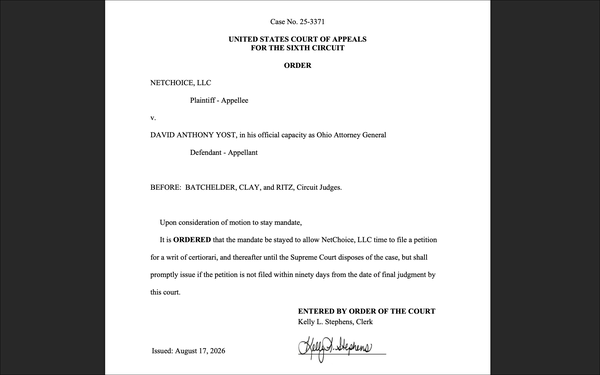
NetChoice recently
said it will ask the United States Supreme Court to intervene, and petitioned the 6th Circuit to delay handing down the mandate until after the Supreme Court weighs in.
The 6th
Circuit granted that request Monday, effectively prohibiting state officials from immediately enforcing the
law.
advertisement
advertisement
Ohio's Parental Notification By Social Media Operators Act (HB33), passed in 2023, generally applies to operators of sites with social features (such as allowing users to
create profiles and interact), and that are aimed at minors under 16 or are “reasonably anticipated” to be accessed by teens under 16.
The law exempts ecommerce
sites that allow people to post reviews, and “established and widely recognized” media outlets that report news.
NetChoice -- which counts large tech platforms
including Meta, TikTok and Google as members -- argued the law restricts minors' First Amendment right to express themselves and access speech, and restricts social platforms' constitutional right to
disseminate speech.
The organization also contended the law was unconstitutionally vague. For instance, NetChoice argued, even though the law exempted "established and widely
recognized media outlets," it didn't define those terms.
U.S. District Court Judge Algenon Marbley sided with NetChoice and blocked enforcement.
He said in a written
opinion that the law was "troublingly vague,” and its restrictions didn't appear tailored to the goal of protecting minors from the potential harms of social media.
Ohio
Attorney General David Yost appealed to the 6th Circuit, where he argued both that NetChoice wasn't in a position to assert that the law violated minors' rights, and that the parental-consent
provisions merely restrict minors' ability to enter into contracts with social platforms.
Circuit Judges Eric Clay and Alice Batchelder both voted to allow enforcement, though
for different reasons.
While both judges said NetChoice wasn't the right party to argue that the law violated minors' rights, they wrote separate opinions regarding whether the
law violated NetChoice members' First Amendment rights.
Clay said in the lead opinion that the law's parental-consent mandate "constitutes a marginal burden that precisely
targets the multi-faceted problem that Ohio has identified: children’s unsupervised assent to terms and conditions for use of platforms that take advantage of and harm them."
Batchelder essentially said in a separate opinion that NetChoice failed to prove that every application of the law would violate its members' rights.
Judge
Kevin Ritz dissented, writing that he believes NetChoice is able to assert the First Amendment rights of its members' teen users, and that the law is unconstitutional.
NetChoice argues in its request to delay the mandate that there is a "reasonable probability" the Supreme Court will agree to take the case, especially because Ohio is just one of many
states to recently pass laws restricting teens' use of social media.
Other states with comparable statutes include Arkansas, Florida, Georgia, Louisiana, Nebraska, Mississippi,
South Carolina, Utah, Texas and Tennessee.
NetChoice and others have challenged many of those laws, and most district court judges have blocked them. But states have appealed
and the 5th Circuit Court of Appeals as well as the 11th Circuit Court of Appeals have so far lifted blocks on laws in Mississippi and Florida.