Commentary

Why Nielsen Keeps Publishing 'The Gouge'

Oops, I mean "The Gauge," but you get my drift.

Footnotes aside, Nielsen has spent months willfully publishing bogus, lame duck data spinning streaming's dominance over linear TV during the upfront even though it knows it is wrong and plans to recalibrate it effective with the new TV season.

What could Nielsen's reason possibly be?

To answer that question, I went back to Nielsen's June 2021 press release announcing "The Gauge" and explaining what it was: "a monthly visualization of how audiences in the U.S. are using streaming services on their TVs, as well as how that usage stacks up to traditional broadcast and cable television. Not only will it provide a high level look at the evolving TV landscape overall, it’ll also reveal how specific streaming services are performing compared to one another."

The problem is that the methodology Nielsen used to generate the monthly reports was inaccurate for several reasons, especially the universe estimates Nielsen used to calibrate streaming vs. linear TV viewing sources in U.S. TV households.

advertisement

advertisement

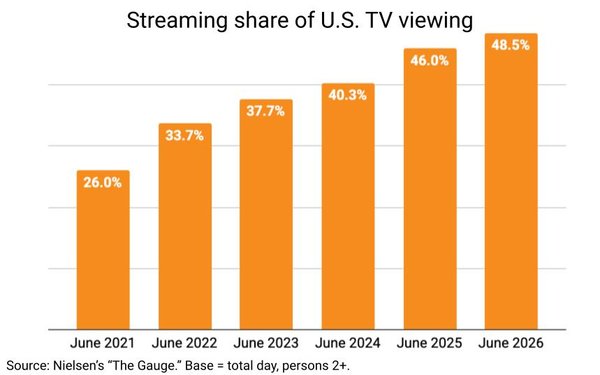
And even though Nielsen was aware of those problems, it continued to publish "The Gauge" reports showing streaming's rapid ascendancy -- indeed its actually leap-frogging over linear TV viewing in May 2025 when it published that year's "June" edition of "The Gauge" -- until the Media Rating Council finally blew the whistle that Nielsen was dragging its feet on fixing "The Gauge's" methodology.

Following some fits and false-starts, including an aborted plan to begin publishing recalibrated "Gauge" data showing that streaming was not actually the dominant TV viewing source -- at least not yet -- Nielsen backtracked and said it would continue publishing "The Gauge" using what it knew to be a bogus methodology until the September.

Hmmm, I wonder what annual media-buying marketplace that lag period coincided with?

We may never know what impact Nielsen's decision to willfully continue publishing unrepresentative TV viewing share data during an upfront negotiating season actually was, but we do know it bought streaming services time to continue spinning their ascendancy while billions of ad dollars were being negotiated.

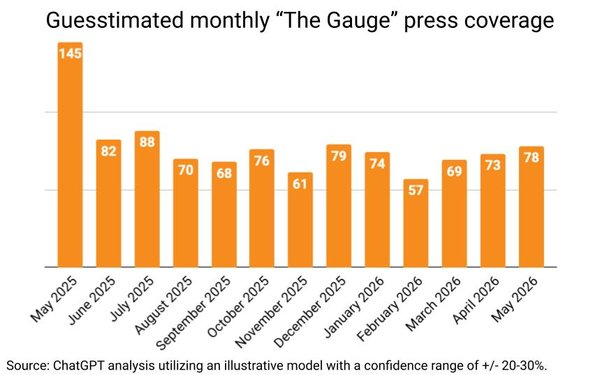
It also generated hundreds of articles published by leading trade publications, wire services, newspapers and blogs reporting on the March through June monthly edition of "The Gauge's" findings, though some at least cited the footnote in the bullseye of "The Gauge's" visualization disclaiming that the data does not actually reflect Nielsen's "currency" TV ratings and that it's methodology would be rebooted to do so with the start of the Fall TV season. You know, after the upfront.

So why did Nielsen make the decision to continue publishing knowingly inaccurate "Gauge" share estimates?

For the only plausible answer I can come up see the graphic below. 

7 comments about "Why Nielsen Keeps Publishing 'The Gouge'".
Check to receive email when comments are posted.
  1. Joshua Chasin from KnotSimpler, August 19, 2026 at 11:07 a.m.

    Hey joe. The thing about the Gauge is that as near as I can tell, it's a marketing piece, not a product. I don't think there's a deeper version of it beyond what's on the website. It's very visible-- especially to people like you and me, who don't have Nielsen subscriptions-- but it probably draws too much attention in the scheme of things. 

    Also-- not trivially-- if I'm prsing th FAQs correctly, it's limited to viewing on TVs, which will tend to favor broadcast/cable.

  2. Ed Papazian from Media Dynamics Inc, August 19, 2026 at 11:41 a.m.

    That's right, Josh. The time buyers and advertisers pay zilch attention to The Gauge--they get far more detailed information as subscribers to Nielsen. The Gauge is really a well intentioned  Nielsen promotinal item that has become overused--and misused---- by non-subscribers, hence something of a problem for Nielsen.

  3. Joe Mandese from MediaPost Inc., August 19, 2026 at 11:43 a.m.

    @Joshua Chasin: You are absolutely right, but the real question is who it is marketing for?


    By willfully continuing to publish data for months -- generating hundreds of trade and consumer press stories citing its data -- even though it already acknowledged the data is incorrect and will be rebooted this fall, Nielsen appears to be perpetuating false data to market the dominance of streaming vs. linear/cable TV during the very same months billions of ad dollars are being spent across those TV/streaming platforms/networks/channels. That's what the column is about.


    Or maybe someone more knowledgeable than me has a better answer?


  4. Jack Wakshlag from Media Strategy, Research & Analytics replied, September 1, 2026 at 2:54 p.m.

    A bit of history. First, to answer your question, Nielsen is marketing for themselves.  When faced with competitors and analysts (you might remember Josh Bernoff and his fantasy research at Forrester) offering a perspective showing huge gains and viewing to digital alternatives, Susan Whiting realized others were doing a job her company could do better, and should.  She decided to stop ceding PR turf to these folks. Before that, Nielsen released little more than program rankings.  So the Guage was born, managed so well by Brian Fuhrer for these many years. 

  5. Joe Mandese from MediaPost Inc., September 1, 2026 at 3:01 p.m.

    @Jack Wakshlag: Which explains why the Guage is publishing fantasy research showing huge gains and viewing to digital alternatives (YouTube, streamers), at least if you believe the ARF's DASH estimates vs. Nielsen's Gauge so far.

  6. Jack Wakshlag from Media Strategy, Research & Analytics replied, September 1, 2026 at 3:30 p.m.

    I agree that it is unwise for The Guage to be based on data that differ from Nielsen's best estimates. 

  7. Ed Papazian from Media Dynamics Inc, September 1, 2026 at 3:37 p.m.

    Joe &Jack, in fairness to Nielsen, it has in the past published free to all, many very useful and far more dtailed reports on media usage than The Gauge. For example Nielsen used to publish quarterly and later annual  reports  defining the reach and time spent by age groups not only for linear TV but also for smartphones, desktop PCs and tablets. They were called "Total Audience Reports" and I am icluding a link--if it takes- to a listing from 2021 for such a report.

    If vyou go to Nielsen's website under "Insights" and under it, "Reports", and go back in tme you may be surprised. 

    As for The Gauge producing wildly inflated streaming fantasy numbers, I suspect that the new ones--based on DASH universe estimates --will be only slightly different--but somewhat lower for streaming--not that any media decisions are being made based on such information. They aren't.

    Link:

    https://www.nielsen.com/insights/2021/total-audience-advertising-across-todays-media/

Next story loading loading..