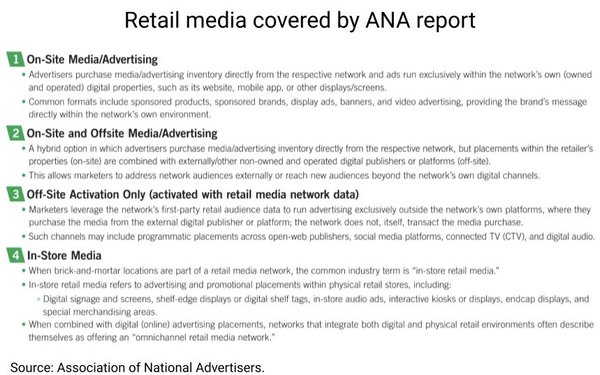
Retail and commerce media account for a large and
growing share of marketers’ media mix, but measurement practices have lagged making it difficult to prove ROI and other campaign outcomes.
An Association of National advertisers (ANA)
member report -- "Retail Media Measurement Standardization" -- released on Tuesday found 55% of advertisers believe the lack of consistent standards is the top barrier to success, despite record ad
spending and growth.
Inconsistent inputs drive inconsistent outcomes, such as attribution lookback windows, an important metric for retail media networks.
Others include “new
to” definitions, identity resolution scope, and varied deduping practices by networks, all of which prevent reliable comparisons across networks to improve return on investments (ROIs).
ANA members are expected to use the findings to establish a baseline for definitions and processes, along with common measurements that addresses these challenges.
advertisement
advertisement
“Baseline
media metrics must be standardized before outcome metrics can be trusted,” the report reads. “Marketers cannot properly evaluate ROI, growth, or incrementality unless the underlying ad
delivery metrics are measured consistently and in line with industry standards.”
One major metric, often used but many times misunderstood, is the link between ad exposure and purchase
of media. This metrics is commonly known as “the lookback window.”
The lookback windows has become inconsistent across networks, resulting in different standards.
To improve consistency in how campaigns are measured, the ANA recommends media networks allow marketers to define customer attribution 14-day lookback window to enable consistent metric
comparisons across networks.
Retail media networks, individual retailer advertising platforms, are projected by Emarketer to grow at a 17% compound annual rate to $90 billion by 2028. When
retail media is expanded to include commerce media networks, which connect multiple retailers and partners, ad spending is expected to exceed $100 billion. Today, more than half of marketers use five
or more commerce media networks.
Members such as Georgia Pacific, Hersey, and Intel stated inconsistent inputs produce inconsistent outcomes, including attribution, varying definitions,
differences in identity resolution, and network-specific deduping practices.
The Retail Media Working Group—Walmart Connect, Target Roundel, Kroger Precision Marketing, among
others—will consider other findings the group has identified to solve a variety of issues that have led to inefficiencies and hinder marketer ROI growth.
These include inconsistent
metrics, definitions and methods, as well as disconnected data in retail media network silos, lack of on-platform experimentation, and poor integration when sharing data.
The report also
recommends advertisers standardize baseline metrics, such as impressions, clicks, viewability, and invalid traffic.