So Meta did what they
probably should have done before they even walked into the courtroom in the U.S. District Court in Oakland. They settled and agreed to pay up to $18 billion.
Under the
settlement terms, Meta must enforce a default two-hour daily limit for minor accounts, mute push alerts during school hours and overnight, turn off "like" counts, and disable cosmetic surgery
filters.
And in a very smart strategic move, Meta built a mechanism into the deal where it pays billions less unless YouTube and TikTok adopt identical rules.
By pushing its
competition into the same judgement, Meta eliminates the risk of losing teenage market share to non-compliant competitors. My prediction is that YouTube and TikTok will fall in line because State
Attorneys General will use the settlement to go after them, and other players in the digital world, if they don’t adjust.
advertisement
advertisement
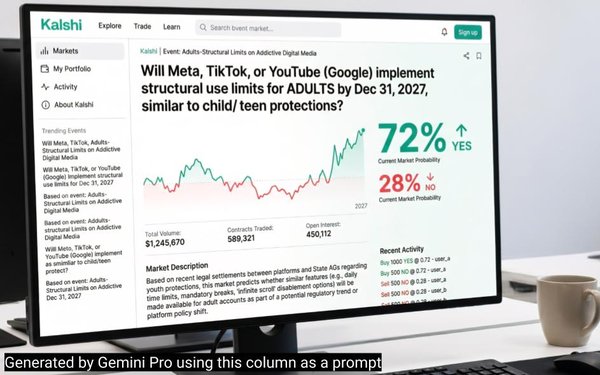
The question is if adults will face similar
limits next? I am going to place a bet on Kalshi that they will. There was already a sentiment among most adults that “too much social media is bad." With this settlement, they now have proof
this is true.
The regulatory playbook matches tobacco, gambling, or ultra-processed foods.
Legislation always starts with protecting children because it offers moral high
ground. But now that courts have established the legal precedent -- that algorithmic design is a dangerous, addicting product feature -- expect most other platforms to protect themselves by
introducing "default-on" friction for everyone.
Features like infinite scroll, late-night push alerts, and auto-playing video reels will eventually be toggled off by
default.
I expect adults will have to manually adjust their settings and sign off on a liability disclaimer just to scroll endlessly after 1:00 AM. And like choosing to smoke or eat unhealthy
foods, that shifts the legal responsibility for unhealthy behavior to the consumer.
The gaming industry should be concerned.
Gaming and gambling companies built
multibillion-dollar businesses on reward mechanisms and loot boxes.
If a social media video feed is legally classified as a mental health hazard, an interactive gaming environment engineered
around social pressure and microtransactions is an equally big target. I expect gaming executives are huddling with their legal counsel as we speak.
Artificial intelligence companies
are probably doing the same.
It took 20 years before social-media platforms faced serious legal accountability. The current wrongful death lawsuit against OpenAI over a teenager's suicide --
filed in the San Francisco Superior Court -- seeks to prove that unmonitored "synthetic intimacy" creates liability.
My guess is that AI companies will implement equally aggressive age
verification, session time limits, and strict conversational boundaries preemptively, purely to avoid costly litigation later.
And remember that none of the AI companies are profitable yet.
The $18 billion for Meta is to be paid over 10 years, meaning that the annual draw-down is only 3% of their 2025 profit.
If your media strategy relies on buying cheap ad views from
adults scrolling at 1:00 AM, your inventory is probably going to disappear.
You shouldn’t have relied on that inventory in the first place, but now is the time to move dollars away from
passive social feeds into channels where users deliberately opt in and pay attention.
Smart marketing leaders won't waste time trying to work around these new limits. They will
rebuild their media strategies around explicit consent, higher creative standards, and real value.
Like they should have done from the start, anyway.