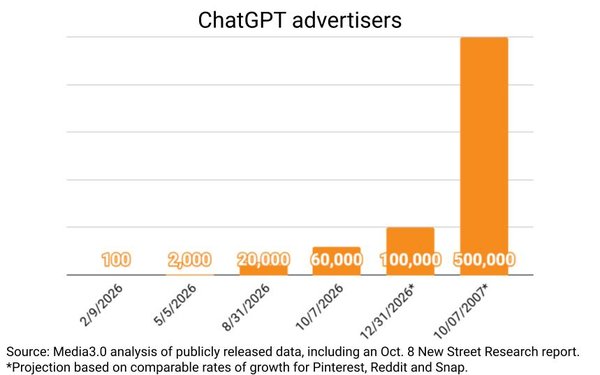
I've been sitting on a report on the accelerated
growth of ChatGPT's advertisers from New Street Research analyst Dan Salmon since the end of last week, but wanted to spend some time calculating, projecting and comparing it to other comparable
fast-growing digital advertising platforms before publishing this. Plus, I'm attending the Institute for Advertising Ethics' second industry summit on AI ad-related ethics today (see below) and
figured this would be a good day to publish this analysis (see above).

Based on an event hosted by OpenAI and AppsFlyer on Oct. 7, Salmon reported that the
number of advertisers now buying ads on ChatGPT is greater than 60,000. That's up from more than 20,000 a little more than a month ago.
advertisement
advertisement
You can probably figure out the rate of progression in
your head, but consider the growth only began with perhaps a hundreds or so advertisers using ChatGPT in February.
Based on comparable rates of growth in the number of advertisers using other
recent fast-growing digital advertising platforms -- Pinterest, Reddit and Snap -- ChatGPT will surpass half a million advertisers within the next year. The Mary Meeker part of me thinks it will
actually be much greater than that given the rapid acceleration of AI usage, but let's be conservative for this analysis and consider it took Facebook nearly six years to reach that number of
advertisers.
More importantly, the same thing that's driving ChatGPT's advertiser growth is the same thing that drove Facebook's: self-service advertising management systems enabling small and
medium size businesses (SMBs) and direct-to-consumer advertisers to use the same platform as the biggest brands -- and agencies -- in the world.
Based on my AI-assisted, back-of-the-envelope
analysis, it was the half million advertiser mark when the SMBs also surpassed the Fortune 1,000 brand advertisers in share of Facebook advertising. And with that, the amount of sway Madison Avenue
had over Facebook began to decay. I'm not saying big brands don't have influence with Facebook parent Meta, but it's more about working with them and their agencies to test and develop new
applications, optimizations and API integrations so they can improve the performance for all advertisers, big and small.
In terms of actually influencing the policies of Meta, well, go out and
see Aaron Sorkin's just released "The Social Reckoning" if you want to dwell in the nostalgia of that.
For those of you who don't want to see that, just recall what happened with the world's
biggest advertisers tried boycotting Facebook for the month of July in 2020. Remember what happened? Facebook's ad revenue rose, not declined, during the quarter. The reason: big advertisers and
agencies are a nice margin, but they are not that influential in terms of policy, much less ethics of big digital platforms raking it in from a self-service marketplace.
The reason I'm drawing
this analogy is that if the ad industry is ever going to influence the frontier AI companies' policies, the time to do it is now, not when they reach the tipping point when big advertisers are "nice
to have," but not necessarily "need to have."
The truth is, we may already have reached that tipping point, because of what WPP Media's Kate Scott-Dawkins calls the "manifest destiny" of the
ad-supported AI marketplace. Can't wait to see how she updates that in a couple of months when she does her year-end forecast in early December.
Lastly, it's worth noting that in the past
several weeks -- at at leas two major ad industry conferences -- fireside chat questions spoke about the "existential" consequences of AI and what the ad industry's role is in that.
In other
words, I can only imagine what a future Aaron Sorkin film called "The AI Reckoning" will be like to watch.