Trying something new here. In the old days we would have called
it a "reporter's notebook."
Think of it as the best drafts, notes and observations of things I would have written more fully about if I had the capacity to get to publish everything I
wanted.
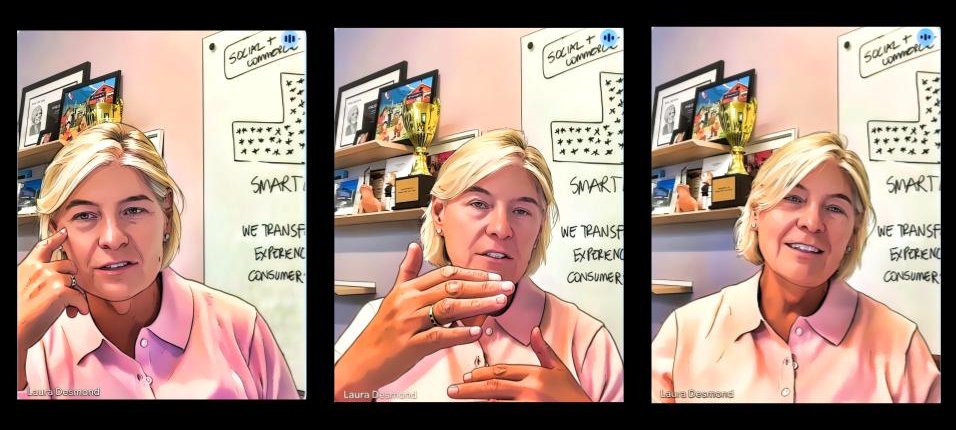
Let's start with Smartly's Laura Desmond and see where we end up.
SMARTLY
“Do you think agencies are going to lose it more than people realize or
do you think they’re going to roar back stronger than people realize," Desmond began our interview last week by asking me -- a trade journalist -- a question instead of the other way around.
"I think it's a constant evolution and reinvention just like every other organization -- clients, tech platforms and the media -- are going through," I replied, adding, "I think technology has
accelerated the pace of disruption and change, and I think we are long past the point where the change is happening on human time. It's now happening on machine time and I think an organization like
Smartly understands that better than most."
advertisement
advertisement
This conversation took place ahead of Smartly's annual conference in New York City this week, the third it has held since Desmond, a long-time
agency media executive became Smartly's CEO.
"Things have moved so much faster than anyone had thought," Desmond reflected, adding, "It's like skipping two or three beats and saying, 'AI is
the important infrastructure of the industry for the future. Now what do we want advertising to be? What do we imagine it can be?"
What does Smartly imagine it will be?
"Three things,"
she said, rattling off:
- More one-to-one marketing.
- Hyper growth of creativity and content.
- Ads become the new conversational UI.
Smartly, you may remember, has been
working with OpenAI to develop new
forms of "conversational" ads powered by ChatGPT.
Desmond characterized the collaboration as still being in the "alpha" phase, but that both companies are learning quickly.
"We are
building that conversational interface," adding, "It will be basic. We are building the interface so as someone prompts, more detail, more consideration, more information about what a person is
looking for will be part of it. The ads aren't jus one-and-done. They will follow the conversation too. Eventually, ads will help propel the conversation forward."
Currently, she says the
conversational experience is being powered by ChatGPT, but Smartly's tech sits on top of OpenAI's API stack.
"We've learned a lot in the past three to four months, but it basically sits on our
platform and the data and intelligence that a brand gains from what people want to interact with is what will power the next series of OpenAI ads," she explained. "But that will also help advertisers
get smarter and have greater decisioning intelligence about what to do next with the ads. It's a continuous feedback loop."
As impressive as that progress is, I asked Desmond if she could give
a sense for how such conversational advertising might evolve when consumers start using their own agents to interact with brands as part of a symmetrical agent-to-agent (A2A) marketplace?
"Who
the heck knows," she admitted, repeating. "Who the heck knows.
"Everyone is trying to figure out what that roadmap is for getting ready for agentic commerce is. I think -- and what I think
some of our smartest clients think -- is that agentic commerce ends up being more of an aggregator, and a summarizer for a human being and humans become the decisioning player in the mix."
That said, Desmond said she also believes people will want to continue to discover and shop on their own accord, because it inherently part of what makes us human.
"What underlies that is
measurement has to change too," Desmond continued noting that "every ten years advertisers have had to embrace a different form of measurement. It was the Nielsen diary to the people meter. Then it
became a marketing mix model. And then it became multi-touch attribution.
"To really fully understand the value and power of this new model, marketers' measurement solutions are going to have
to evolve too," she predicted adding that Smartly's view is that "incrementality" measurement is going to be a key part of that.
I ended the interview by asking Desmond the same question she
opened things up by asking me: What does she think the future of agencies will be?
“I believe avertisng is a cornerstone of free markets and western democracy and that the role
agencies play is vital to helping marketers understand consumers and making their business grow,” Desmond said, adding, “That’s the ‘what’ and the ‘why.’ The
‘how’ is going to change.”
EXISTENTIAL ANGST
There's an inside joke among journalists considering a trend story that goes like this:
Based on that somewhat unscientific math, I observed some existential angst about AI manifesting in the ad
industry during several conversations in the past week. The first two were proffered during two different industry conferences: the Advertising Research Foundation's CIMM (Coalition for Innovative
Media Measurement) summit in New York City, and the ANA's own AI conference in Oxon Hill, MD.
During his summit interview with IAB chief David Cohen, CIMM's Jon Watts asked if he had any
perspective on recent whistleblower warnings about AI exterminating the human race. Cohen quipped that the didn't think that would be a "good thing."
Later
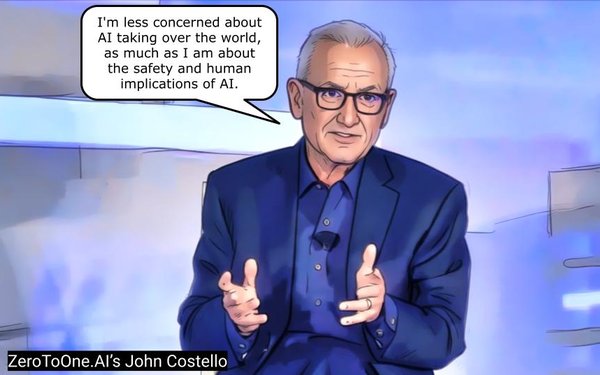
in the week, ANA chief Bob Liodice asked ZeroToOne.AI's John Costello what he thought.
“There’s been a lot of news lately about safety concerns – ‘slow it
down’ – to understand the true impact on society. Do you feel that AI should be regulated," Liodice asked.
"I think we need an aspect of self-regulation," Costello replied, citing
the difficulty governments have keeping up with technological advance. "They're representing their constituency, which tends to be more interested in their life today vs. five years in the
future."
"I'm less concerned about AI taking over the world," he added, "as much as I am about the safety and human implications of AI."
Lastly, during my interview with Smartly's
Desmond I asked here a version of the same existential question.
“What do you think about pressing pause now," I asked Desmond, "especially when you’re so deep in it at this
point?
Following an uncomfortably long pause, she replied, “I would have expected that policy-making and governance be in place by some of the leading countries in the world. I
would have also expected that some of the industry trade groups lead too. That really has to be accelerated now.”
Noting that AI so far has been a case of industrial
self-regulation, she said she believed there also is a need for federal oversight and even more self-regulation, advocating some kind of "incident reporting and control.
"We need some
reporting of not just when things go right, but when things go wrong and how we learn from that to sure there’s a safety web in place," Desmond said, “That gives us confidence that we can
keep operating this way."
THE
RESONATOR
Bill Harvey resonated. And I don't just mean that in the way he championed the idea -- something that stays in your mind and forms a deep, lasting connection.
I
mean that too, but whenever I'd hear him speak, I swear I could also visualize Bill Harvey vibrating in a physical sense. In an almost harmonic way.
The first time I observed it was in
the early 90s when Harvey was pitching a roomful of industry execs on a plan to aggregate the data generated by people clicking across the internet to find out what media -- and advertising --
resonated most with them.
He made the case that this new behavioral data would be a better way for advertisers to understand what made people click.
He was right, of course.
It's too bad it wasn't a neutral, third-party like Harvey's Next Century Media that pulled it off, instead of it ending up behind the walls of platforms that would end up monopolizing
advertising.
Even so, Harvey never gave up on the idea and continued to thinking big about new and varied ways of organizing people's media behavior data.
He spent years researching
marketing science, as well as neuroscience to come up with a proprietary "neuro-motivational" method of targeting people programmatically.
"It’s a method of making ads better, placing
the ads in places where the context helps, and sending it to people who are predisposed to receiving the message positively," Harvey said in my last interview with him a few months ago.
I'll
confess, the interview wasn't one of my best as Harvey tried to compress decades of research and iteration into a story I had difficulty following because much of it was over my head.
But he
was particularly excited about the findings of a recent study conducted by the Wharton School's neuroscience department that effectively validated Harvey's own research showing.
The study
measured the brainwaves of people shown different ads across different media platforms -- conventional TV, streaming, YouTube and Facebook -- and found which of the brainwaves correlated with the
likelihood someone would buy the advertiser's product.
And while I couldn't understand some of the technical detail of the findings, I could tell that to Harvey, at least, it was a Holy Grail
moment.
For months, I agonized over my notes, trying to figure out how to tell this story until Harvey's recent passing, so I thought I'd at least share the anecdote to
explain the privilege of covering Bill Harvey even if I wasn't always capable of reporting on much of what he shared with me.