Publishers have been pushing the industry to monetize AI chat. On
Friday, in a blog post, OpenAI explained how they will soon get their wish.
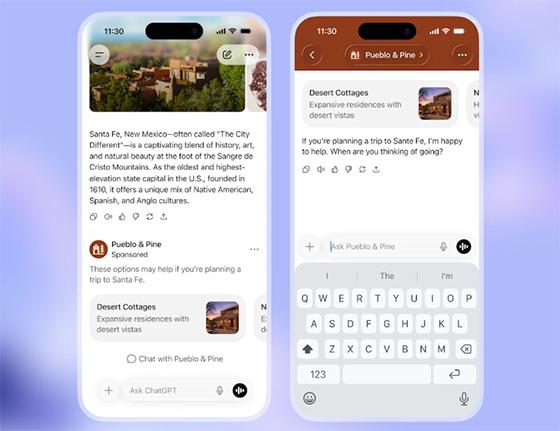
OpenAI said today that it will soon begun testing ads in the U.S. in its free ChatGPT tool and ChatGPT Go
tiers. These allow people to use its AI tools with fewer limits or without having to pay for the technology. Plus, Pro, Business, and Enterprise subscriptions will not include ads.
In August
2025, OpenAI introduced ChatGPT Go in India as a low-cost subscription service designed to expand access to ChatGPT’s popular features.
Since then, ChatGPT Go has rolled out to 170
additional countries. On Friday, it rolled out everywhere the chatbot is available. In the U.S., ChatGPT Go is available for $8 per month.
The blog post that describes how OpenAI will use ads
reads like a throwback to the early days of Google. "The best ads are useful, entertaining, and help people discover new products and services.”
advertisement
advertisement
Compare that comment with something
Google founders believe, documented in a post that describes the company's early days: "And we firmly
believe that ads can provide useful information if, and only if, they are relevant to what you wish to find so it’s possible that certain searches won’t lead to any ads at all.”
OpenAI's philosophy suggests conversational interfaces create possibilities for people to go beyond static messages and links.
For example, soon users might see an ad and be able to
directly ask the questions you need to make a purchase decision, according to OpenAI's blog post.
It seems this has materialized not a moment too soon. Publishers are hurting as marketers try
to monetize their web sites.
Adie Kaye, director of strategic innovation at Smartly, acknowledged in a LinkedIn post that publishers are in a "spiral of trying to add more monetization to
dwindling traffic, as the traffic becomes more and more expensive to acquire."
He made the comment in reference to Duration Media CEO Andy Batkin calling out the Interactive Advertising
Bureau (IAB) for not adding monetization-focused sessions for publishers in its 2026 Annual Leadership Meeting agenda, arguing the organization has abandoned publishers.
"There are, of course,
the walled garden products that aim to collaborate with other publishers/IP owners -- e.g. the YouTube Partner Program, TikTok Pulse Premiere, etc. They work for revenue, but at the cost of
effectively becoming tenants on someone else's platform," Kaye wrote.
The interesting wildcard, per Kaye, is monetized AI chat.
Duration Media's Batkin wrote "Publishers are in
crisis" and "ad impressions, in some cases, are down by 40%."
Batkin has been in the industry for 31 years, and participated in creating the IAB in 1996, "back when it was ONLY for
publishers," he wrote.
He made a list of sessions, and then wrote "Here's what I DON'T see - A SINGLE session on helping publishers generate NEW revenue." Then called on publishers in
attendance to teach brands what "happens when the content ecosystem fails." Give them real solutions, along with a webinar series that provides actionable ideas that publishers can use today.
Batkin's post received 30 comments from across the advertising industry. One of those, along with an apology, came from David Cohen, chief executive officer of the IAB.