AI loomed large during
the two days of the Advertising Research Foundation’s CIMM (Coalition for Innovative Media Measurement) summit in New York City this week, including the realization that the ad industry may be
on the verge of a paradigm shift from excluding traffic generated by bots to explicitly targeting them as proxies or representatives of consumers.
It’s an epiphany I’ve
written a number of times here over the past couple of years, as well as something I routinely ask on panels – or in one-on-one conversations with industry sources – dealing with the role
AI agents will have in the not-to-distant future.
I’m glad to see some big industry thinkers are starting to take it seriously.
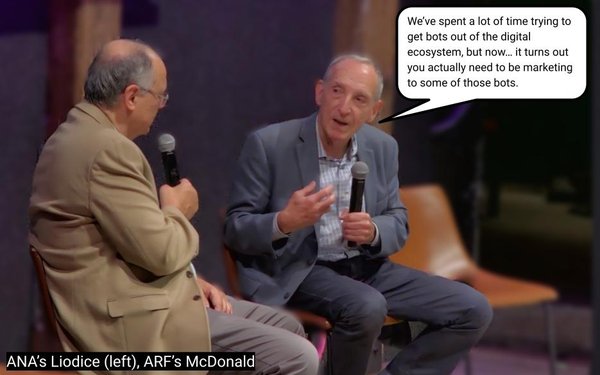
“We’ve spent a lot of time
trying to get bots out of the digital ecosystem, but now it turns out with gen AI you actually need to be marketing to some of those bots," soon-to-be-retiring ARF chief Scott McDonald quipped during
a CIMM fireside chat with soon-to-be-retiring Association of National Advertisers chief Bob Liodice, noting, "You need to be distinguishing between the good bots and the bad bots, because some of them
are likely to be your customers or the representatives of your customers."
advertisement
advertisement
McDonalds also disclosed that the next big thing to come out of the ARF will be a publication addressing the role of
AI-generated "synthetic" consumer data, including how to "pressure test" it and validate it at a company level.
"It's not an impossible task and can actually accelerate adoption," he
hinted.
Interestingly, the ARF recently published a prescient white paper -- "Accelerating Marketing Effectiveness Analytics In The Age Of AI" -- written
by former Sequent partners Jim Spaeth and Alice Sylvester -- which deals mainly with the role AI already is playing in advanced advertising and media effectiveness modeling, for good and bad.
But it is the role AI will increasingly play in so-called A2A (agent-to-agent) marketing that I've been most interested in, because it is a paradigm shift I believe will for the first time create a
symmetrical marketplace between consumers and brand marketers.
Ironically, I developed that belief more than a quarter century ago when the ARF invited me to be a fly-on-the-wall journalist
covering a months-long collaboration with the MIT Media Lab to map the outcomes digital media would have on advertising. Dubbed "Project D-Map," it culminated with a futuristic scenario in which
consumers and brands would each have digital "filters" determining when consumers were a match for something an advertiser was offering.
Today, we would call those filters "agents," but the
idea is the same: each side of the consumer marketplace would have digital technology representing their interests, weeding out irrelevant offers, ads and media impressions, and making the whole
process more symmetrical and efficient.
Obviously, a true A2A market structure has not yet emerged, and given my own experience covering ad industry innovation for nearly half a century, I
wouldn't be surprised if the industry -- aided and abetted by Big Tech -- figured out a way to bypass consumer agency once again, but I'm betting that someone -- or some thing -- will figure out a way
to preserve and maybe even enhance consumer agency in the process.
I know that's something the Institute for Advertising Ethics and the IEEE have been collaborating on in a series of industry
discussion, which are aligned with the principles espoused by Project VRM's "MyTerms"
-- a new technical standard for creating machine readable interchanges between consumers and businesses that want to do business with them, or more ostensibly, between their agents.
But
comments like the ARF's McDonald's makes me believe that there finally is a broader ad industry recognition about a symmetrical, agent-to-agent mediated future emerging.
To McDonald's actual
quip to Liodice about the ad industry targeting bots vs. weeding them out, I'd also like to remind you that digital traffic verification service DoubleVerify has already taken a step in that direction, announcing the first
service validating "non-human" audience traffic late last year.
I should also remind you, that Nielsen subsequently announced a deal to acquire DoubleVerify for a couple of billion
dollars. Hmm, I wonder why?
McDonald told Liodice the ARF's shift to embracing agents as proxies and/or representatives of actual consumers is part of a broader shift by the foundation from
"measuring media to measuring people," even if those people happen to be represented by a new form of agentic media.
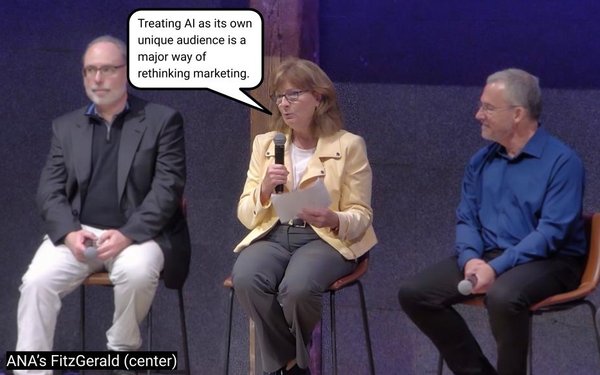
"Advertising to AI agents -- treating AI as its own unique audience -- is a
major way of rethinking marketing," ANA Vice President of Data Excellence & Privacy Joan FitzGerald said during an AI-focused panel discussion on Tuesday. Describing it as "machine
marketing," she said, "that's what marketers are going to be doing in the future."
That said, she acknowledged that the ad industry has not yet "tackled how we are going to advertise to AI
agents."
She then cited a recent Time magazine "case study" in which the
publisher created "two different versions" of its website with two different versions of ads: "one to target humans and one to target AI agents. And a big name LLM threw up all over it and said
that violated their policies.
"We sort of stepped back at the ANA and said, 'Should this violate the policies?' Why is it illegal to advertise to AI agents? We need to identify them. We need
to figure out what they want. We need to enable transactions."
"I've commented to [Media Rating Council chief] George Ivie that
the MRC has spent so much time identifying and excluding non-human traffic," added panel moderator Josh Chasin of KnotSimpler, adding, "And that's going to have to be revisited."
Consumer
marketing paradigm shifts aside, this week's CIMM summit tackled some related -- and in at least one case -- far more existential questions.
"There's obviously been a lot of talk recently
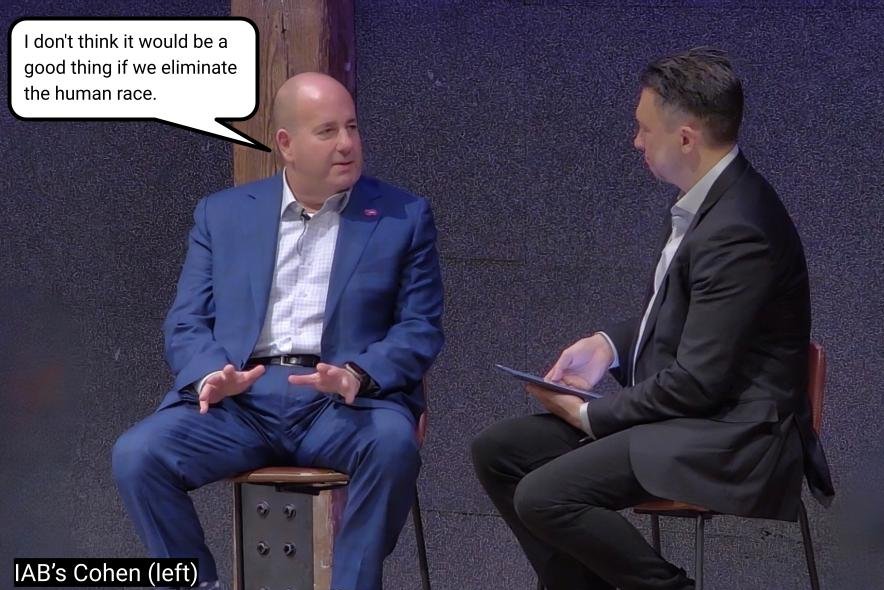
about the impending extinction of the human race," CIMM's Jon Watts primed IAB chief David Cohen during their stage chat, adding, "Do you have a perspective on this?"
"I don't think it would
be a good thing if we eliminate the human race in ten years," Cohen replied.