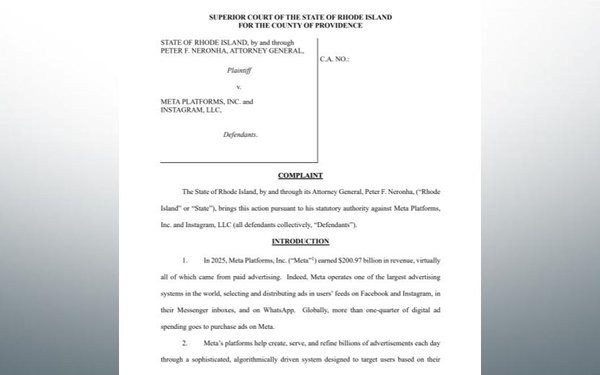
Rhode Island is suing Meta Platforms for allegedly helping to "create and optimize" ads
for contraband as well as ads that aimed to bilk consumers.
"Meta represents to the public that it detects, blocks, removes, and 'aggressively' combats fraud and scams on its
platforms and removes deceptive advertising from its platforms," Attorney General Peter Neronha alleged in a complaint filed last week in Providence County Superior Court.
"In reality, Meta has knowingly
distributed to unsuspecting users large volumes of fraudulent advertisements," the complaint continues.
The complaint includes a claim that Meta violated the state's consumer
protection law by representing that it "detects, prevents, removes, and suppresses fraudulent and illegal activity on its platforms."
advertisement
advertisement
The suit is one of several similar cases
against Meta, which is facing increased scrutiny and litigation over online fraud. Currently, the company is being sued over fake ads by the watchdog Consumer Federation of America, Santa Clara County and consumers.
The Federal Trade Commission also recently launched a proceeding that could result in regulations requiring Meta
and other online platforms to combat fraudulent ads by scammers who impersonate businesses and government agencies.
Rhode Island's Neronha claims in the lawsuit that Meta knew
"an unconscionable share of its advertising revenue" was due to fraudulent ads or ads for drugs, stolen merchandise or other "restricted" products such as tobacco. The suit specifically alleges that
10% of Meta's 2024 revenue or $16 billion reportedly came from those ads -- a figure reported last year by Reuters.
"Rather
than address this fraud, Meta knowingly helped create and optimize these ads to ensure that they were as effective as possible and then lied about them, misrepresenting to the public its commitment to
prevent fraud on its platform," the suit alleges.
"In addition, to protect its advertising revenue and (falsely) project an image of constant growth, Meta knowingly tolerated
millions of fake accounts, which it (falsely) reported publicly as users of its platforms," the complaint alleges. "Among other harms, these fake accounts helped legitimize and distribute fraudulent
ads as scammers created and leveraged these accounts to engage with their other accounts to both make their ads appear mainstream and to boost their distribution by Meta’s algorithm."
A Meta spokesperson says the company will fight the "unfounded" lawsuit.
"The Attorney General refused to engage with us on ways we protect Rhode Islanders from
scams," the spokesperson said. " We fight scams because they're not good for us or the people and businesses that rely on our services. In the past year alone, we have partnered with law enforcement
to disrupt criminal scam networks around the globe, removed over 159 million scam ads, and launched new tools to protect people."