It was August 2006.
Facebook was barely two years old and MySpace—yes, MySpace—was the seventh most visited site in the US. I had just written my very first eMarketer report about social network advertising,
and I made a bold proclamation: “Social networking is a powerful concept that will not go away. The underlying idea is so compelling that it will influence advertising in all media.”
Nearly 20 years later, AI platforms are at a similar inflection point. They are creating a tectonic shift in how people find information and how advertisers will reach
them.
Why do I feel confident saying this? Because AI platform usage is mirroring the early trajectory of social media—and AI ad spending may already be outpacing
social’s initial years.
advertisement
advertisement
In mid-2025, about two and a half years after ChatGPT’s launch, 38% of US desktop internet users were using AI tools monthly,
according to Datos. That’s identical to the adoption rate for social networking at the end of 2006, about two years after Facebook’s launch.
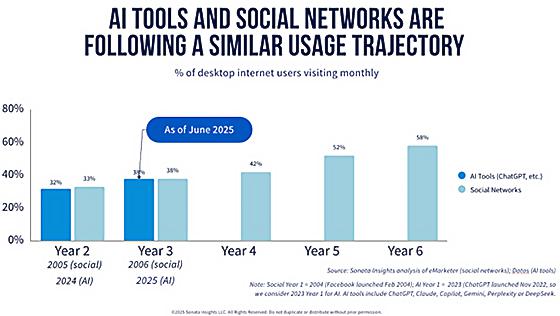
Meanwhile, AI search ad spend may already be ahead of early social
spend. In 2006, US advertisers spent just $350 million on social network advertising. This year, US AI search ad spending will be triple that, at $1.05 billion, eMarketer projects.
On the
surface, there’s not much AI has in common with social media. Social media is where people go to express themselves and connect with others. Using AI is typically a solitary experience; it lacks
the human connection that made social media so magnetic.
But under the hood, a few important similarities are emerging.
Data is the
fuel.
Social media grew as an ad medium because platforms like Facebook figured out how to mine users’ behavioral, demographic and digital usage data—the
quid pro quo for free access—and build powerful ad targeting systems.
AI search platforms also capture vast amounts of data—the intent-based
information about what people ask, how they refine their queries and the choices they ultimately make. And the ad targeting, when it arrives at scale on these platforms, will be equally powerful, as
will the retargeting opportunities.
Walled gardens are the engine.
Advertisers that flocked to Facebook, Twitter and other platforms
quickly realized they were facing their own quid pro quo: They had to accept that these social platforms were closed ecosystems—walled gardens—that controlled ad performance
data.
AI search is shaping up the same way: Platforms like ChatGPT are becoming a gateway to consumer intent. If their early dealings with publishers are any indication,
these platforms will guard user data closely, making it difficult for partners to extract value.
Trust and brand safety are the bumps in the road.
Misinformation, fake news and bad actors continue to plague social media, damaging user trust and creating brand safety concerns. Yet usage and ad spending are still rising, showing
that those concerns aren’t strong enough to change behaviors.
AI search faces similar challenges, including hallucinations, incorrect information and unclear
sourcing. But there’s little evidence that concerns about accuracy or manipulation are deterring consumers, and the brand safety issue that’s top of mind for marketers right now is how
they appear in AI responses, not how the surrounding content will affect them.
With these common threads, it’s clear that what ties social media and AI search
together isn’t just their similar usage trajectories. It’s that both are built not just on consumer appeal, but on monetizing consumer intent and attention.
In the nearly two decades since my first research about social media, it has ballooned into a $100 billion ad market in the US, according to eMarketer. AI search is likely to reach a
similar—or even greater—scale in the coming decades.
Debra Aho Williamson is the founder and chief analyst of Sonata Insights, a research and advisory service operating at the intersection of consumer behavior, marketing and AI. Debra was among the first analysts in
the world to identify social media as a major marketing trend, and she led the social media research practice at eMarketer for 17 years.
If you’re interested in
submitting content for future editions, please reach out to our Managing Editor, Barbie Romero at Barbie@MediaPost.com.