General Motors' new global headquarters
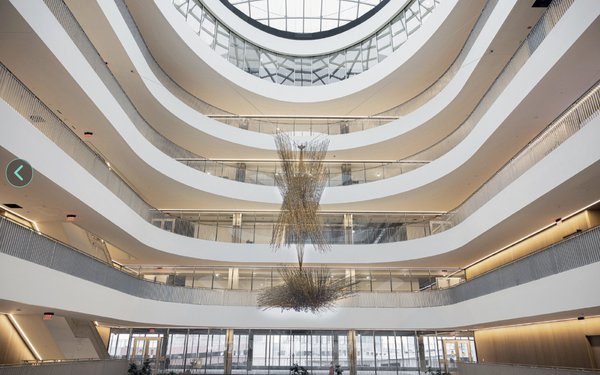
in downtown Detroit will feature a once-lost Harry Bertoia sculpture which connects the automaker to a former Detroit retailer.
The automaker is moving to the new Hudson's
Detroit building, which was built on the site of the longtime and beloved former J.L. Hudson flagship department store.
Bertoia’s connection to General Motors precedes his
connection to Hudson's. His first public sculpture installation was commissioned for the General Motors Global Technical Center in Warren, Michigan in 1953.
In 1970, when
Bertoia was an established leader in modernist sculpture, the J.L. Hudson Company commissioned an installation for the Genesee Valley Mall in Flint, Michigan. Bertoia’s creation was monumental
in size, yet delicate in appearance: a 26-foot-tall sculpture that takes the form of two large clouds, constructed of steel wire coated in melted brass, bronze, and metal alloys.
advertisement
advertisement
In
1980, when the mall was shuttered for renovation, the sculpture was moved to another mall in Southfield, Michigan. There, it vanished from public view for decades; when the Northland Mall was later
demolished, it was feared that the Bertoia installation had been lost for good.
Miraculously, in 2017, appraisers from the Southfield Arts Commission discovered the lost Bertoia
beneath layers of dirt in the basement of the demolished mall. The City of Southfield then purchased the artwork, and restoration was begun.
Installing the sculpture at the new HQ
was a massive undertaking. A five-story-high opening had to be “unzipped” in the side of the Hudson's Detroit building. The sculpture was threaded through the 15-foot-wide, 75-foot-tall
opening in two pieces, involving a complex ballet of chain-falls and cranes to safely transport the historic artwork.
“Having a Harry Bertoia sculpture in our new global
headquarters in Hudson’s Detroit is incredibly meaningful,” said Crystal Windham, executive director of industrial design at General Motors, in a release. “Bertoia was a master at
shaping metal, a principle that resonates deeply with our work in automotive design. His iconic screen at Cadillac House at Vanderbilt on our Global Technical Center campus is a legendary part of our
design heritage. Now, this magnificent piece, with its own story of being lost and found, bridges GM’s past with our future. It serves as a daily inspiration, a powerful symbol of the creativity
and resilience that has always defined both General Motors and the city of Detroit.”