Commentary

The Federal Censorship Commission

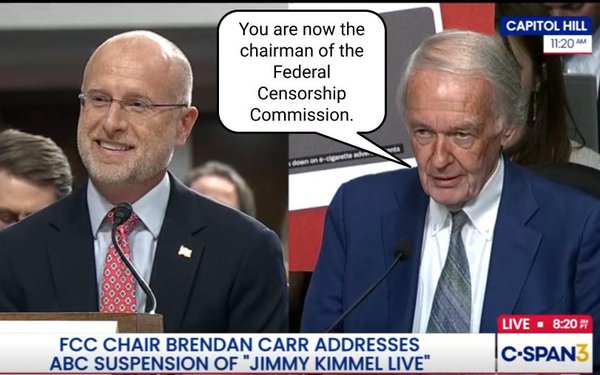
The most poignant split-screen moment during FCC Chairman Brendan Carr's testimony before Congress Wednesday happened when Senator Ed Markey gave new meaning to the agency's acronym.

"You are now the chairman of the Federal Censorship Commission," Markey said, to which Carr guffawed in a way that seemed like he was taking it as a compliment.

It was a telling moment, because despite some obligatory, partisan back-slapping from Republican senators during the hearing, Carr didn't exactly smile, much less laugh, during the hearing.

You can watch the moment for yourself in the clip below, but to me it seemed like a badge of honor to Carr -- who before being appointed FCC Chair by Trump was the author of the FCC section of the Heritage Foundation's Project 2025 blueprint for restructuring the federal government.

advertisement

advertisement

Why else would he have been so tickled by the characterization? It's not like he was all laughs about comparisons of his "We can do it the easy way, or the hard way" Jimmy Kimmel suspension campaign to "Goodfellas" and "mafia threats."

1 comment about "The Federal Censorship Commission".
Check to receive email when comments are posted.
  1. Mark Winslow from Winslow Media, December 18, 2025 at 3:32 p.m.

    Interesting piece, but it's worth remembering that government pressure on social media content moderation wasn't invented by Republicans.

    Under the Biden administration:Mark Zuckerberg publicly stated in 2024 that senior White House officials 'repeatedly pressured' Meta for months to censor COVID-19 content, including humor and satire, and that he regretted complying in some cases.

    The Missouri v. Biden (later Murthy v. Missouri) case uncovered extensive communications where the White House, CDC, FBI, and other agencies flagged posts and urged platforms to remove or suppress content on COVID vaccines, election integrity, and even the Hunter Biden laptop story. A federal judge initially called it an 'almost dystopian' censorship effort, and the 5th Circuit found likely First Amendment violations (though the Supreme Court later ruled on standing).

    Internal documents (e.g., Twitter Files, House Judiciary reports) showed platforms changing policies in response to Biden admin demands, including censoring true information that didn't violate their own rules.

    Both sides have raised valid free speech concerns at different times—let's hold all administrations accountable without selective memory.

Next story loading loading..