It’s the end of the year,
so it’s time to reflect and also to look forward, carrying what we’ve learned in the past into an uncertain future.
Let me share one thing I’ve learned: We have to get
serious about how we create community. And by community, I will use a very specific definition. In fact, perhaps it would be more accurate to replace “community” with
“choir.”
Let me explain my thought with a story.
In the late 1980s, Harvard professor Bob Putnam was in Italy doing research. He was studying Italy’s regional
decentralization of power which began in 1970. For a political scientist like Putnam, this was an opportunity that didn’t come often. Italy had passed power down to its 20 regional governments
and had also established a single framework for administration and governance. This framework was the constant. The variables were the people, the societal environment and the nature of the regions
themselves. If anyone is familiar with Italy, you know that there are vast differences between these regions, especially from the north to the south.
advertisement
advertisement
Putnam looked at how effective each
administrative government was. Was democracy working in the region? Even though the administrators were all referring to the same playbook, the results were all over the map, literally.
Generally speaking, governance in northern and central Italy was much more effective than in the south.
For Putnam, the next big question was, why? What was it about some regions that made
democracy work better than in others? Was it education? Wealth? Occupational breakdowns? In examining each factor, he found some correlation, but they all came short of the perfect positive
relationship he was looking for.
Finally, he took a break from the analysis and drove into the country with his wife, Rosemary. Stopping in one town, he heard music coming from a small
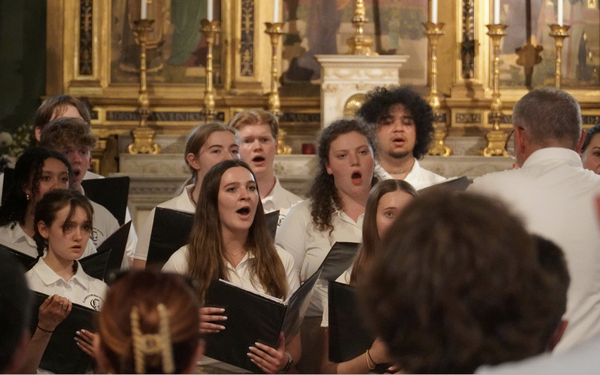
church, so the two stepped inside. There, a volunteer choir was singing. It may sound clichéd, but in that moment, Bob Putnam had an epiphany. Perhaps the answer lay in people coming
together, engaging in civic activities and creating what is called “social capital” by working together as a group.
Maybe democracy works best in places where people actually want
to sing together.
Bob Putnam looked at the numbers again and, sure enough, there was almost a perfect correlation. The regions that had the most clubs, civic groups, social organizations and,
yes, choral societies also had the highest degree of democratic effectiveness.
This set Putnam on a path that would lead to the publishing of this work in 1993 under the title of “Making
Democracy Work,” along with his subsequent 2000 bestseller “Bowling Alone.” (If you’d like to know more about Putnam, check out the excellent Netflix documentary “Join or
Die.”)
Putnam showed it’s better to belong, but that only explains part of the appeal of a choir. There has to be something special about singing together.
Singing as a
group is one of those cultural universals; people do it everywhere in the world. And we’ve been doing it forever, since before we started recording our history.
Modern science has
now started to discover why. Singing as a group causes the brain to release oxytocin -- christened the “moral” molecule by neuro-economist Paul J. Zak -- by the bucketload. Zak explains
the impact of this chemical: “When oxytocin is raised, people are more generous, they’re more compassionate and, in particular, they’re empathetic -- they connect better to
people emotionally.”
An oxytocin high creates the building blocks of trust and social capital. People who sing together treat each other better. Our brains start tuning into other brains
through something called neural synchrony. We connect with other people in a profoundly and beautifully irrational way that burrows down through our consciousness to a deeply primal level.
But
there’s also something else going on here that, while not unique to singing together, finds a perfect home in your typical community choir.
Sociologist Émile Durkheim found that
groups that do the same thing at the same time experience something called “collective effervescence.” This is the feeling of being “carried away,” being part of a whole
greater than the sum of its parts. You find it in religious ceremonies, football stadiums and rock concerts. And, yes, you’ll find it in choirs.
So, if singing together is so wonderful,
why are we doing it less and less? When was the last time you sang -- really sang, not just moved your lips -- with others?
For myself, it’s beyond the limits of my own memory. Maybe it
was when I was still a kid. And I suspect the reason I haven’t sung out loud since is because someone, somewhere along the line, told me I can’t sing.
But that’s not the
point. Singing shouldn’t be competitive, but spiritual. We shouldn’t judge ourselves against singers we see in the media.
This never used to be the case. It’s just one
more example of how we can never be good enough -- at anything -- if we use the media for our mirror.
So in 2026, I’m going to try singing more. Care to join me?