Every year, Marketing Daily runs
"most-read" lists. I've always treated them as a necessary evil. They are easy to write in a week when not much real news happens, but rarely all that revealing.
This year, though, my own list
surprised me.
Two of my 10 most-read stories weren't tied to any single company at all. One "CMOs Have Lost Their Clout. Can They Ever Get It Back?" -- included
existential angst from a leading McKinsey researcher. Another, "The Rising Risks Of DEI Gone
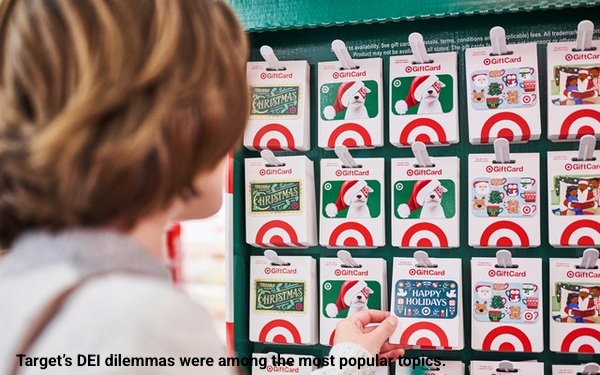
Dark," addressed the stark erasure of words like “equity” and “inclusion” from marketing playbooks. (No. 11 on my list, by the way, was all about Target’s DEI struggles, and another piece on the financial impact of DEI-linked boycotts landed in this year's Top 10 “Top of
the News” stories.)
advertisement
advertisement
This clustering doesn't feel accidental. It feels more like a tell. Because 2025 often felt chaotic for marketers, our audience seemed most drawn to stories that
named the unease beneath the noise. As DEI receded -- politically, culturally, and in some cases operationally -- so did a clear framework for purpose-driven marketing. For many CMOs, that retreat
raised an uncomfortable question: If purpose is no longer the thing we organize our values and messaging around, then what is?
And then there's AI, which showed up everywhere this year --
including in my own work habits. ChatGPT's year-in-review informed me that I landed in the top 3% of message senders, a byproduct of trying to use AI the way many marketers do: as a thinking partner,
an editor, and occasionally something to argue with. It also tells me, a little accusingly, that I used more than 16,000 em dashes along the way.
That personal overuse mirrors a larger
industry condition. Marketing leaders built their careers on judgment, taste, and big human ideas. Suddenly, much of the conversation revolves around automation, efficiency, and systems designed to
think faster -- if not better -- than people do. One of my most-read CPG stories was about a high-impact pickle campaign based on an AI-created idea. Readers
clicked because it worked, but also, I suspect, because it unsettled them. If a machine can generate a hit campaign concept, where does that leave the humans in the room?
Readers also
gravitated toward stories about brands taking clear creative risks. Dick’s
Sporting Goods made headlines with its cheeky Draymond Green "naughty list" campaign. JCPenney committed to a bold rebrand. These weren't stories about playing it safe
or optimizing incrementally -- they were about brands with a point of view, willing to act on it.
And then there was Mars. One of my most-read stories this year was a Q&A with a Mars marketer who takes Halloween so seriously that he holds companywide meetings
in costume. In a year of uncertainty about authority and influence, readers seemed hungry for examples of leaders who still believe culture, creativity, and conviction matter -- and are willing to act
like it.
Heading into 2026, the big questions remain unresolved. AI will keep accelerating. DEI will remain a third rail -- too risky to name aloud, but still fundamental as companies try to
reach new customers. And CMOs will still be asked to prove their value in systems increasingly designed to optimize, not inspire. If this year's readership patterns say anything, it's that marketers
aren't just watching these shifts -- they're trying to figure out who they need to become to stay relevant inside them. The answer, I think, will have less to do with the tools they use and more to do
with whether they can still defend a creative point of view when the pressure is on to let the system decide.